
Understanding Choghadiya & Auspicious Muhurat 2026: Timing Cosmic Energy & Day-Night Calculations
Choghadiya is an ancient Vedic time-division system that splits day and night into eight equal periods ruled by planetary deities, enabling quick, highly accurate timing decisions without casting full horoscopes.
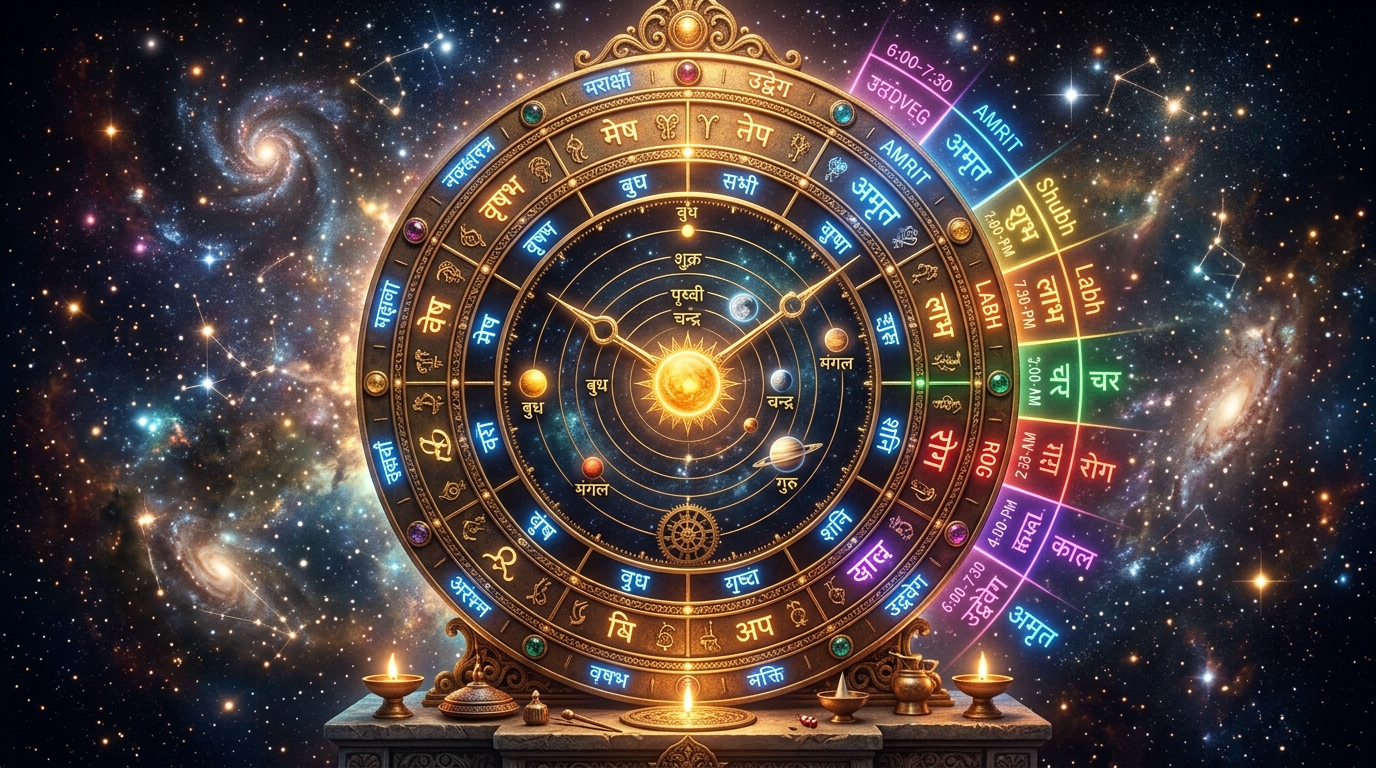
🕉️ 1. The Mathematics of Solar Division: From Sunrise to Sunset
Vedic timekeeping does not measure civil days from midnight to midnight; a civil day commences at astronomical sunrise (Suryodaya). The total duration between sunrise and sunset (Dinamana) is divided mathematically into eight equal segments, constituting the Day Choghadiya.
Similarly, the interval from sunset until the next morning sunrise (Ratrimana) is divided into eight equal segments, forming the Night Choghadiya. Because solar coordinates vary by city and season, precise astronomical calculations are essential.
🕉️ 2. The 7 Choghadiya Archetypes: Auspicious, Neutral & Inauspicious
There are seven planetary types distributed across the eight segments, repeating sequentially:
- Amrit (અમૃત - Nectar): Ruled by the Moon. The supreme muhurat for all tasks, health, religious rites, and beginning journeys.
- Shubh (શુભ - Auspicious): Ruled by Jupiter (Guru). Ideal for weddings, puja, financial investments, and entering new houses.
- Labh (લાભ - Beneficial): Ruled by Mercury (Budha). Best for starting business ventures, trade, signing contracts, and schooling.
- Char (ચલ - Dynamic/Moving): Ruled by Venus (Shukra). Excellent for travel, vehicle purchases, machinery, and moving forward.
- Udveg (ઉદ્વેગ - Agitation): Ruled by the Sun (Surya). Inauspicious for social or financial peace; only acceptable for government filings.
- Kaal (કાળ - Loss/Time): Ruled by Saturn (Shani). Avoid starting new endeavors or signing assets; can lead to delays and friction.
- Rog (રોગ - Malady/Conflict): Ruled by Mars (Mangal). Inauspicious; avoid health treatments, purchases, or new partnerships.
🕉️ 3. Practical Decision Matrix for Modern Life
Whenever you need to schedule an important event — such as signing a real estate agreement, driving a new car from the showroom, taking medicine, or performing Griha Pravesh — consulting the live Choghadiya clock on Sanatan Hindu Calendar guarantees cosmic synchronization.
If an urgent matter arises during an inauspicious Choghadiya, Vedic texts suggest offering a prayer to Lord Ganesha, sipping Gangajal, or waiting for the subsequent Amrit or Shubh period.
❓ Frequently Asked Questions (AEO & Vedic Q&A)
Choghadiya derives from 'Chau-Ghadi' (four Ghadis). In traditional Indian timekeeping, one Ghadi is 24 minutes. Four Ghadis equate to roughly 96 minutes (1 hour and 36 minutes), though exact lengths fluctuate with seasonal sunrise and sunset variations.
The three unequivocally auspicious Choghadiyas are Amrit (ruled by Moon/Mercury, best for all works and spirituality), Shubh (ruled by Jupiter, ideal for ceremonies and contracts), and Labh (ruled by Mercury, ideal for business, commerce, and learning). Char is neutral and excellent for travel and vehicles.
Choghadiyas are not pegged to standard clock time; they are calculated relative to local astronomical sunrise and sunset. As daylight lengthens or shortens across the seasons and varies by geographical latitude, the duration of each period shifts dynamically.
The first Choghadiya immediately following sunrise is ruled by the lord of that weekday (Varadhipati). For example, Sunday begins with Udveg (Sun), Monday with Amrit (Moon), Tuesday with Rog (Mars), Wednesday with Labh (Mercury), Thursday with Shubh (Jupiter), Friday with Char (Venus), and Saturday with Kaal (Saturn).