☀️ 1. Makar Sankranti & Uttarayan 2027: Exact Date, Sun Transit & Astronomical Timing
Makar Sankranti (also revered as Uttarayan in Gujarat and Western India) is one of the most auspicious solar festivals in the Sanatan Hindu calendar. It marks the divine celestial moment when Surya Bhagwan (the Sun God) concludes his journey through Dhanu Rashi (Sagittarius) and transits into Makara Rashi (Capricorn), inaugurating Uttarayana—the sacred six-month northward cosmic journey of the Sun.
In the year 2027, based on high-precision Drik Siddhanta ephemeris calculations, the exact moment of Makara Sankranti occurs on Thursday, January 14, 2027 at 09:11 PM IST (21:11 hours). Because this solar ingress transpires at night after sunset, ancient Vedic calendar authorities including Nirnaysindhu and Dharmasindhu prescribe specific scriptural rules:
Scriptural Siddhanta Rule (Nirnaysindhu / Dharmasindhu):
"यदि रात्रौ संक्रान्तिः स्यात् तदा परेद्युः पूर्वभागे पुण्यकालः।"
When Sankranti occurs during the night (after sunset), the holy bathing (Snan), ancestral tarpan, and charity (Daan) Punya Kaal is observed on the following morning (Friday, January 15, 2027) from sunrise onwards. Consequently, in 2027, the grand kite flying, festive gatherings, and public celebrations across Gujarat and India take place on Thursday, January 14, 2027 (Uttarayan), while the sacred religious rituals of river bathing, charity, and Vasi Uttarayan are joyously observed on Friday, January 15, 2027.
| Astronomical / Panchang Milestone | Calculated Timing (IST) | Scriptural Context & Guidelines |
|---|---|---|
| Makara Sankranti Moment (Sun Enters Capricorn) | Thursday, 14 January 2027 at 09:11 PM | Nirayana Sun crosses 270° celestial longitude into Makara |
| Universal Cultural Observance (Uttarayan Kite Festival) | Thursday, 14 January 2027 | Full day public celebration, kite flying, Undhiyu & Jalebi |
| Ritual Punya Kaal (Auspicious Snan & Daan Window) | Friday, 15 January 2027 (07:19 AM – 12:46 PM) | Primary scriptural period for holy bath and donations |
| Maha Punya Kaal (Highest Karmic Merit Window) | Friday, 15 January 2027 (07:19 AM – 09:00 AM) | First 4 ghatis from sunrise; ideal for Ganga snan and Gau-daan |
| Vasi Uttarayan & Kaanum Pongal Celebration | Friday, 15 January 2027 (All Day) | Second day of kite flying, community feasts and visits |
| Paush Lunar Tithi on Jan 14 & Jan 15 | Paush Shukla Shashthi into Saptami | Shashthi ends Jan 14 at 02:01 PM; Saptami ends Jan 15 at 02:15 PM |
To track local sunrise times, planetary coordinates, and live tithi transitions for your specific city, consult our Daily Vedic Panchang.
🌊 2. Auspicious Punya Kaal & Maha Punya Kaal Timings for Snan & Daan
In Vedic tradition, performing sacred river dips (Tirtha Snan) and charity (Daan) during the Punya Kaal and Maha Punya Kaal yields inexhaustible spiritual merits (Akshaya Phala). It is believed that charity offered during this period cleanses past karmic debts and invites health, longevity, and abundance from Surya Dev.
Because the solar transit occurs at 09:11 PM on Thursday night, the entire morning of Friday, January 15, 2027 is consecrated as the Punya Kaal. The exact calculated windows are:
| Muhurat Classification | Time Duration (IST) | Recommended Spiritual Observances |
|---|---|---|
| Maha Punya Kaal (महापुण्य काल) | 07:19 AM – 09:00 AM (15 Jan 2027) | Sacred river bath, Surya Gayatri Japa, donating black sesame, copper & gold |
| Punya Kaal (पुण्य काल - Morning Half) | 07:19 AM – 12:46 PM (15 Jan 2027) | Surya Arghya, Gau-daan (cow feeding), Khichdi distribution, family puja |
| Extended Punya Kaal (Till Sunset) | 12:46 PM – 06:14 PM (15 Jan 2027) | Donating blankets, woollens, til-gud sweets, and food to the needy |
| Abhijit Muhurat (Jan 15) | 12:25 PM – 01:08 PM (15 Jan 2027) | Universally auspicious mid-day window for starting spiritual vows |
Note: Across India, sunrise times vary slightly by geography. Devotees in Varanasi, Haridwar, Kolkata, Prayagraj, and Delhi should begin their morning Snan-Daan immediately upon local sunrise. To verify precise auspicious hours for your city, view our Live Choghadiya & Auspicious Muhurats.
🕉️ 3. Sacred Snan-Daan Vidhi, Surya Arghya & Powerful Vedic Mantras
The rituals of Makar Sankranti unite devotional worship of the Sun God with practical humanitarian charity. Following the scriptural guidelines ensures maximum spiritual elevation:
A. Sacred Til Snan (Sesame Bath)
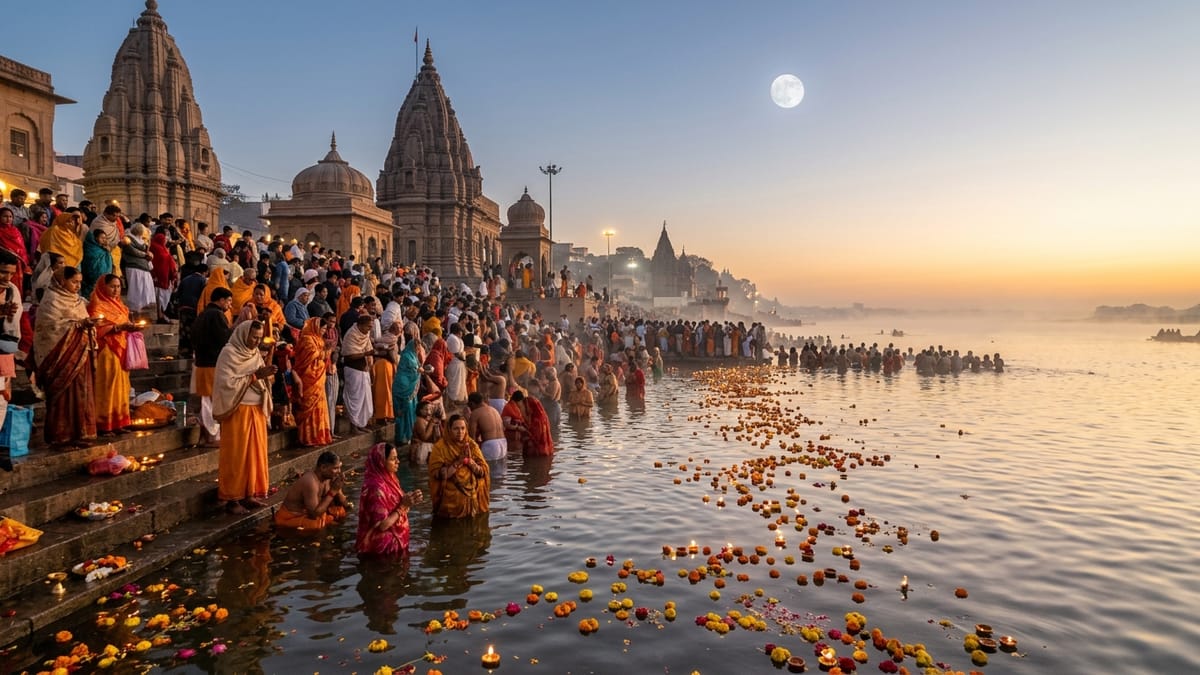
On both January 14 and January 15, wake up during Brahma Muhurta (around 05:30 AM). If you cannot visit sacred rivers like the Ganga, Yamuna, Narmada, or Godavari, add a few drops of holy Gangajal and a pinch of black sesame seeds (Til) to your bathing water at home. Chanting the sacred river invocation invokes the sanctity of all seven holy tirthas:
गंगे च यमुने चैव गोदावरि सरस्वति। नर्मदे सिंधु कावेरि जलेऽस्मिन् संनिधिं कुरु॥
(O Holy Waters of Ganga, Yamuna, Godavari, Saraswati, Narmada, Sindhu, and Kaveri, please sanctify this water with your divine presence.)
B. Surya Dev Arghya Vidhi
Fill a pure copper vessel (Tamra Patra) with fresh water. Add red sandalwood paste (Raktachandan), fresh red flowers, a pinch of turmeric, unbroken rice grains (Akshat), and a few black sesame seeds. Stand facing the eastern horizon towards the rising Sun and slowly offer the water in three gentle streams while keeping the vessel above your forehead so that the morning sunlight refracts through the flowing stream onto your body.
ॐ सूर्याय नमः • ॐ घृणि सूर्याय नमः
ॐ आदित्याय विद्महे मार्तण्डाय धीमहि तन्नः सूर्यः प्रचोदयात्॥
(Salutations to Lord Surya, the celestial soul of the universe. May his divine light stimulate our intellect and awaken spiritual consciousness.)
C. Seven Meritorious Items for Makar Sankranti Daan
Vedic texts highly praise donating specific satvik items on Makar Sankranti to harmonize planetary influences and generate auspicious karma:
- Black & White Sesame Seeds (Til): Signifies pacification of Lord Shani (Saturn) and Rahu, removing obstacles and ill-health.
- Jaggery (Gud): Governed by Surya Dev (Sun) and Brihaspati (Jupiter), donating jaggery bestows fame, respect, and high vitality.
- Khichdi (Raw Rice, Black Urad Dal & Salt): Donating raw Khichdi ingredients to Brahmins or the underprivileged removes poverty and balances planetary energies.
- Warm Woollens & Blankets: Providing warm shawls and blankets to the poor during peak winter shields the donor from acute distress and sudden mishaps.
- Brass or Copper Vessels: Represents purity and abundance, invoking Goddess Lakshmi's perpetual presence in the household.
- Green Fodder for Cows (Gau Ghas): Feeding fresh grass and jaggery to Mother Cow (Gau Mata) eliminates the sins of a lifetime and brings family peace.
- Fresh Seasonal Harvest (Sugarcane, Ber/Bor, Groundnuts): Symbol of gratitude to Mother Nature for a bountiful harvest.
To learn how solar transits affect your birth chart and Janam Kundli, explore our free Vedic Janam Kundli & Horoscope Engine.
🌅 4. Auspicious Choghadiya Muhurat Windows on Uttarayan & Vasi Uttarayan
Planning your festive celebrations, temple visits, and charity distributions in harmony with auspicious Choghadiya divisions amplifies peace, prosperity, and joy for your entire household. Here are the calculated Drik Choghadiya muhurats for Gujarat and Western India on both festive dates:
Thursday, 14 January 2027 (Uttarayan Day Choghadiya)
| Choghadiya Division | Type & Nature | Calculated Timing (IST) | Recommended Festive Activities |
|---|---|---|---|
| Shubh (શુભ) | Highly Auspicious | 07:19 AM – 08:41 AM | Morning prayers, Surya Arghya, early terrace setup, til-gud prasad |
| Char (ચલ) | Dynamic / Favorable | 11:24 AM – 12:46 PM | Rooftop kite flying, community social visits, outdoor festivities |
| Labh (લાભ) | Prosperous (Gains) | 12:46 PM – 02:08 PM | Festive lunch of Undhiyu-Jalebi with extended family, new plans |
| Amrit (અમૃત) | Supreme Nectar | 02:08 PM – 03:29 PM | Peak kite competitions, family joy, charity distribution |
| Shubh (શુભ) | Joyous & Good | 04:51 PM – 06:13 PM | Sunset lantern releases (Tukkals), tea gatherings, family blessings |
Friday, 15 January 2027 (Vasi Uttarayan & Punya Kaal Day Choghadiya)
| Choghadiya Division | Type & Nature | Calculated Timing (IST) | Recommended Festive Activities |
|---|---|---|---|
| Char (ચલ) | Auspicious Dawn | 07:19 AM – 08:41 AM | Maha Punya Kaal Snan, river dips, Surya Japa & Arghya |
| Labh (લાભ) | Gains & Abundance | 08:41 AM – 10:03 AM | Major Daan-Punya, feeding cows, distributing blankets & food |
| Amrit (અમૃત) | Supreme Blessings | 10:03 AM – 11:24 AM | Temple darshan, religious discourses, second-day kite flying |
| Shubh (શુભ) | Favorable & Peaceful | 12:46 PM – 02:08 PM | Vasi Uttarayan family meals, honoring guests and elders |
| Char (ચલ) | Pleasant Evening | 04:52 PM – 06:14 PM | Closing festivities, peaceful reflection and evening lamps |
For real-time shifting day and night Choghadiya countdowns calibrated to your exact GPS location, check our Live Choghadiya Clock.
📖 5. Puranic Legends: Surya-Shani Reconciliation, Bhishma Moksha & Ganga Avataran
Makar Sankranti is steeped in sacred Puranic heritage that underscores reconciliation, selfless duty, and liberation:
1. The Divine Reconciliation of Surya Dev and Lord Shani
According to the Surya Purana, Lord Shani (Saturn) is the son of Surya Dev and Chhaya. Due to misunderstandings, father and son experienced a long period of estrangement. On the day of Makar Sankranti, Surya Dev magnanimously visited his son's house—the zodiac sign of Makara (Capricorn), ruled by Shani. Welcoming his radiant father with deep reverence, Shani Dev offered him black sesame seeds (Til). Pleased by his son's humility, Surya Dev blessed Shani that whenever he enters Makara Rashi, all who worship both with Til and Gud will be freed from troubles and blessed with prosperity. Thus, Makar Sankranti is the festival of mending broken relationships and fostering family harmony.
2. The Vaikuntha Departure of Bhishma Pitamaha
In the epic Mahabharata, the venerable grandsire Bhishma Pitamaha was blessed with Iccha Mrityu (the boon of choosing the time of his death). Severely wounded on the battlefield of Kurukshetra, he lay on a bed of arrows (Sharashayya) for weeks, patiently waiting for the sun to transition into Uttarayan. In Vedic philosophy, Uttarayan represents the Devayana path—the six-month radiant northern trajectory that leads departing souls directly to higher spiritual realms without rebirth. As soon as the sun entered Makara Rashi, Bhishma willingly surrendered his mortal breath and attained supreme liberation (Moksha).
3. The Descent of Holy Mother Ganga (Ganga Avataran)
On this sacred day, Goddess Ganga, answering the arduous penance of King Bhagiratha, flowed down from the locks of Lord Shiva across the plains of Bharat and followed Bhagiratha to Sage Kapila's hermitage at Ganga Sagar in Bengal. Her holy waters sanctified the ashes of the 60,000 sons of King Sagara, delivering them from all sins into heavenly realms. This miraculous event is commemorated annually by millions of pilgrims taking a holy dip at the Ganga Sagar Mela and Prayagraj Triveni Sangam.
4. Victory of Lord Vishnu over the Asuras
The Bhavishya Purana records that Lord Vishnu ended the tyranny of terrifying Asuras on this day by severing their heads and burying them beneath the Mandara mountain, marking the triumph of righteousness (Dharma) over negative forces.
To discover all major annual vrats and their sacred stories, browse our comprehensive Hindu Festivals & Vrats Calendar.
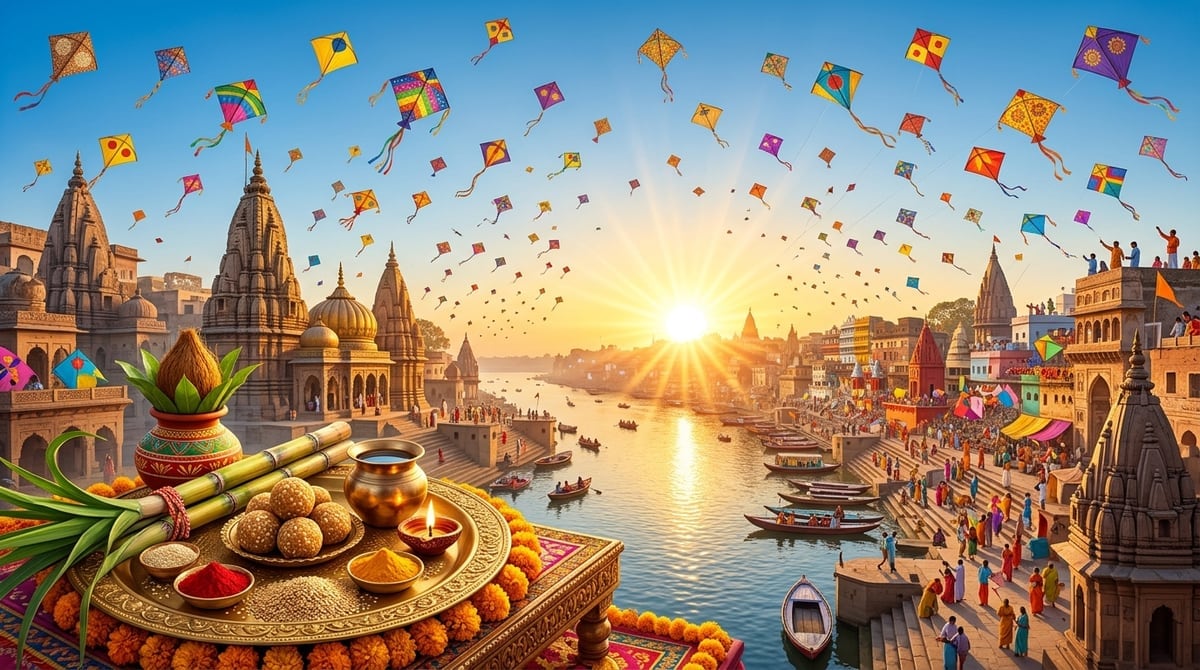
🪁 6. Vibrant Pan-Indian Celebrations: Uttarayan, Pongal, Magh Bihu, Khichdi & Tilgul
Makar Sankranti is one of the few pan-Indian celebrations that unites the entire subcontinent under diverse cultural expressions while celebrating the same cosmic and agricultural milestone:
| Region / State | Festive Name | Key Traditions, Cuisine & Rituals |
|---|---|---|
| Gujarat & Western India | Uttarayan & Vasi Uttarayan | Spectacular rooftop kite flying with cries of "Kai Po Che!" and "E Lapet!", relishing spicy Undhiyu, crispy Jalebi, Til Chikki, Sing Chikki, Mamra Ladoo, and fresh sweet Ber. |
| Tamil Nadu | Thai Pongal (தைப்பொங்கல்) | 4-day festival: Bhogi, Surya Pongal, Mattu Pongal & Kaanum Pongal. Boiling freshly harvested rice with jaggery and milk in decorated clay pots until it overflows shouting "Pongalo Pongal!". |
| Maharashtra & Goa | Makar Sankranti & Haldi-Kunku | Exchanging colorful sesame-jaggery sweets with the heart-warming greeting: "Tilgul ghya aani god god bola" (Accept sweet tilgul and speak sweet words). Married women celebrate Haldi-Kunku. |
| Andhra Pradesh & Telangana | Pedda Panduga (పెద్ద పండుగ) | Grand 4-day festival with Bhogi bonfire, Makara Sankranti, Kanuma, and Mukkanuma. Intricate Muggu rangolis with cow dung Gobbemma balls and singing Haridasu minstrels. |
| Uttar Pradesh, Bihar & North | Khichdi Parv / Makar Sankranti | Massive holy dips at Prayagraj Triveni Sangam (Magh Mela), Varanasi, and Haridwar. Cooking, eating, and donating black urad dal and rice Khichdi with ghee, papad, and chokha. |
| Punjab & Haryana | Maghi (ਮਾਘੀ) | Celebrated immediately following Lohri bonfires. Commemorates the 40 immortal Sikh martyrs (Chali Mukte). Devotees take early morning holy dips in sarovars and eat Kheer cooked in sugarcane juice. |
| Assam & North East | Magh Bihu / Bhogali Bihu | Harvest festival featuring tall thatched bamboo and hay bonfire towers called Meji and Bhelaghar. Feasting on traditional rice cakes (Pitha) and sesame treats (Laru). |
| Karnataka | Suggi Habba (ಸುಗ್ಗಿ ಹಬ್ಬ) | Exchanging Ellu-Bella (a fragrant mixture of white sesame, roasted gram, dried coconut, and jaggery) saying "Ellu bella thindu olle maathadi" (Eat sesame-jaggery and speak only good). |
| Kerala | Makaravilakku at Sabarimala | Culmination of the 41-day Mandala pilgrimage. Lakhs of Ayyappa devotees gather at Sabarimala to witness the sacred jewel procession (Thiruvabharanam) and the divine Makara Jyothi light. |
🌱 7. Scientific, Health & Seasonal Wisdom of Til-Gud, Sun Exposure & Kite Flying
Sanatan Dharma seamlessly interweaves physical wellbeing with spiritual festivals. The traditions of Makar Sankranti embody brilliant seasonal wisdom tailored for the human body at the peak of winter:
1. The Nutritional Science of Sesame (Til) and Jaggery (Gud)
During mid-January, the human body experiences dry, cold environmental conditions that depress immunity and stiffen joints. Sesame seeds are an extraordinary natural superfood: they are loaded with bioavailable calcium (boosting bone density), zinc, copper, magnesium, and healthy unsaturated fatty acids that lubricate body tissues from within. Jaggery (Gud) contains unrefined iron, minerals, and natural sugars that stimulate the digestive fire (Jatharagni), warm the core circulatory system, and cleanse the respiratory tract of winter toxins.
2. Sun Exposure & Natural Vitamin D Synthesis
Winter days in the northern hemisphere have shorter daylight hours, leading to widespread sub-clinical Vitamin D deficiency and seasonal affective disorders. By encouraging families to spend entire days outdoors on open terraces flying kites and socializing under the early morning and mid-day sun, Makar Sankranti provides prolonged exposure to natural Ultraviolet-B (UVB) rays. This triggers endogenous Vitamin D3 synthesis, stimulates melatonin regulation, boosts skin health, and revitalizes vitality.
3. Ocular & Physical Therapy through Kite Flying
Kite flying is an ancient therapeutic exercise. Focusing on distant kites moving across a blue sky exercises the ciliary muscles of the eyes, mitigating modern digital eyestrain and myopia. Simultaneously, tilting the head back and maneuvering the thread flexes the neck, shoulders, and spine, counteracting sedentary posture fatigue.
A Responsible & Compassionate Uttarayan Plea:
While enjoying the exhilaration of kite flying, let us practice compassion towards all living beings. Avoid Chinese manja, glass-coated nylon threads, or flying kites during early morning dawn and late evening dusk when birds fly to and from their nests. Keep your terraces safe, handle threads responsibly, and ensure a joyous, injury-free festival for both humans and our avian friends!