🔱 1. Dattatreya Jayanti 2026: Exact Date, Purnima Tithi & Astrological Muhurat
Dattatreya Jayanti (affectionately revered as Datta Jayanti) celebrates the divine advent of Bhagwan Dattatreya, the supreme Adi-Guru and unified incarnation of the sacred Hindu Trinity—Lord Brahma (the Creator), Lord Vishnu (the Preserver), and Lord Shiva (the Transformer). This most sacred festival is celebrated annually on the Purnima (Full Moon day) of Margashirsha month in the Sanatan Hindu calendar.
According to classical Vedic Siddhanta and sacred Puranas (including Brahmaanda Purana and Sri Gurucharitra), Lord Dattatreya manifested on earth during the auspicious Pradosh Kaal (evening twilight) on Margashirsha Purnima. In the year 2026, astronomical calculations confirm the following precise timings:
Scriptural Timing Rule for Dattatreya Jayanti:
"मार्गशीर्षे पौर्णमास्यां प्रदोषे दत्तजन्म च। तस्मात् प्रदोषव्यापिनी ग्राह्या सर्वसंमता॥"
Because Lord Dattatreya took birth during Pradosh Kaal, the day on which Margashirsha Purnima prevails during evening twilight is consecrated for Datta Jayanti celebrations. On Wednesday, December 23, 2026, Purnima tithi begins at 10:47 AM and covers the entire evening Pradosh window (05:45 PM to 08:22 PM), concluding at 06:57 AM on December 24. Therefore, Wednesday, December 23, 2026 is the universal, scripturally verified date for Dattatreya Jayanti.
| Panchang & Astronomical Milestone | Calculated Timing (IST) | Scriptural Significance & Guidelines |
|---|---|---|
| Dattatreya Jayanti 2026 Observance Date | Wednesday, 23 December 2026 | Margashirsha Shukla Purnima, Vikram Samvat 2083 |
| Margashirsha Purnima Tithi Begins | 23 December 2026 at 10:47 AM | Commencement of auspicious Full Moon fasting & snan |
| Margashirsha Purnima Tithi Concludes | 24 December 2026 at 06:57 AM | End of lunar Purnima; morning Parana hours |
| Pradosh Kaal Janmotsav Muhurat (Prime Window) | 05:45 PM – 08:22 PM (23 Dec 2026) | Exact advent time; Maha Puja, Aarti, Naivedya & Bhajan |
| Abhijit Muhurat (Mid-day Auspicious Hour) | 11:54 AM – 12:44 PM (23 Dec 2026) | Ideal for starting Gurucharitra Path or Datta Stotra |
| Prevailing Nakshatra & Yoga | Rohini Nakshatra & Shubha Yoga | अत्यंत auspicious lunar mansion for devotion and peace |
| Day Shubh Choghadiya Slots | Labha (07:10 AM - 08:28 AM), Amrita (08:28 AM - 09:46 AM), Shubha (11:03 AM - 12:21 PM) | Favorable windows for early morning snan and temple visits |
| Night Shubh Choghadiya Slots | Shubha (07:13 PM - 08:55 PM), Amrita (08:55 PM - 10:37 PM) | Ideal for evening Maha Aarti, Datta Bavani & meditation |
To calculate live city-wise sunrise, sunset, and local choghadiya hours on this auspicious day, consult our Live Vedic Choghadiya & Daily Panchang.
✨ 2. Divine Birth Legend: Sage Atri, Mata Anasuya and the Advent of the Trimurti
The miraculous manifestation of Bhagwan Dattatreya is celebrated as the triumph of selfless maternal love, spiritual purity, and unshakeable chastity (Pativrata Dharma). According to ancient Puranas, Maharshi Atri, one of the revered Saptarshis, and his devout wife Mata Anasuya performed severe austerities seeking a divine son who would guide mankind through the trials of Kali Yuga.
Hearing of Mata Anasuya's unmatched spiritual glow, the divine consorts—Goddess Saraswati, Goddess Lakshmi, and Goddess Parvati—desired to test her virtue. They requested their divine husbands—Lord Brahma, Lord Vishnu, and Lord Shiva—to visit Anasuya's hermitage in the Chitrakoot forest disguised as ascetic guests (Bhikshus).
When Maharshi Atri was away gathering forest offerings, the Trinity arrived at the hermitage demanding food, but placed an impossible condition: Anasuya must serve them unclothed (Digambara bhiksha). Undaunted and possessing profound yogic perception, Mata Anasuya realized the cosmic identity of her guests. With a mother's serene compassion, she sprinkled holy water (Kamandalu Teertha) upon the three deities, uttering:
The Divine Transformation:
Instantly, by the power of her unblemished chastity, the supreme Gods of creation, preservation, and dissolution transformed into three innocent, cooing newborn infants! Mata Anasuya joyfully cradled them in her lap and fed them motherly milk with boundless purity, rocking them in a single cradle.
When Narada Muni informed the celestial goddesses that their husbands had become babies in Anasuya's hermitage, Saraswati, Lakshmi, and Parvati arrived in humble contrition, seeking forgiveness and begging for their spouses' original forms. Upon Maharshi Atri's return, Mata Anasuya restored the deities. Overwhelmed by her devotion, the Tridevas asked the couple for a boon. Atri and Anasuya prayed that the three deities remain with them as their sons.
Granting the boon, the Trinity combined their supreme cosmic energies: Brahma incarnated as Chandra (Soma), Shiva manifested as Durvasa Muni, and the integrated essence of Vishnu embodying the complete Trimurti manifested as Bhagwan Dattatreya. Because he was "Datta" (bestowed as a divine gift) to Sage "Atri", he was reverently named Dattatreya (Datta + Atreya).
🕉️ 3. Sacred Iconography & Esoteric Symbolism of Lord Dattatreya
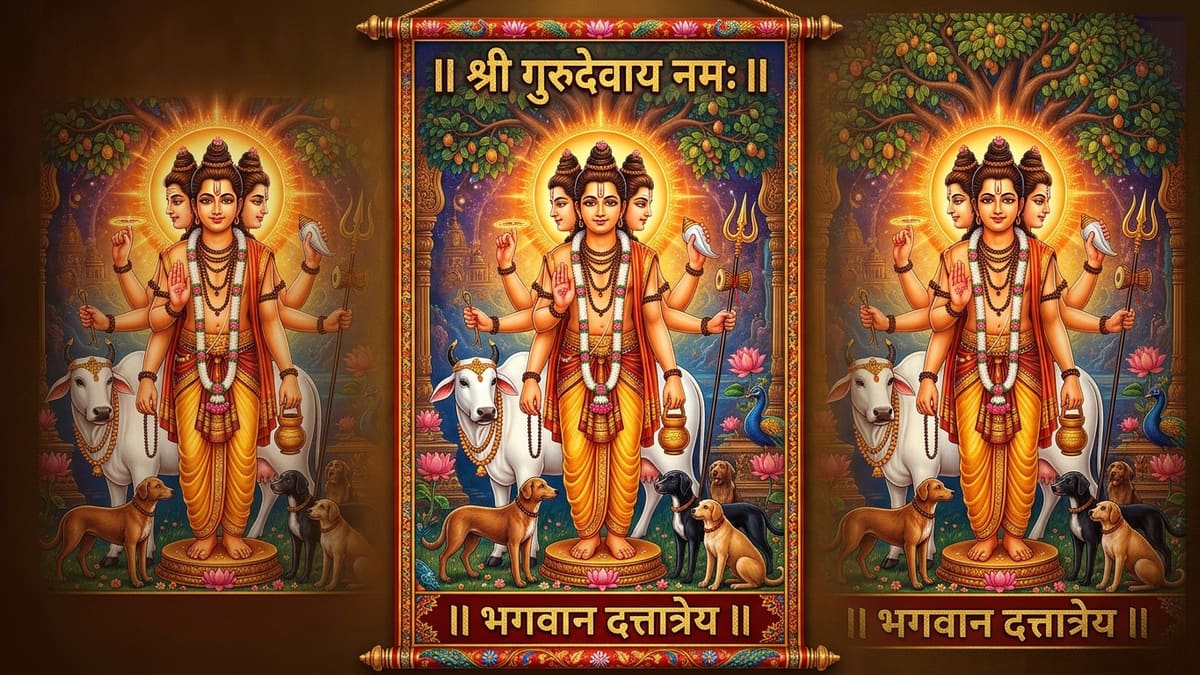
Every aspect of Lord Dattatreya's divine form carries profound spiritual symbolism, unlocking the secrets of Vedic philosophy, cosmic balance, and Advaita Vedanta (non-dualism):
| Iconographic Feature | Sacred Emblem | Esoteric Spiritual Meaning |
|---|---|---|
| Three Divine Heads | Brahma, Vishnu & Shiva | Transcending the three Gunas (Sattva, Rajas, Tamas), the three states of consciousness (Waking, Dreaming, Deep Sleep), and the three phases of time (Past, Present, Future). |
| Conch (Shankha) | Lord Vishnu's Emblem | The primordial sound of creation (Pranava Nada 'OM') that awakens the soul from the slumber of spiritual ignorance. |
| Discus (Sudarshana Chakra) | Lord Vishnu's Weapon | The relentless wheel of time (Kaal Chakra) and cosmic order (Dharma) that destroys ego and karmic attachments. |
| Trident (Trishula) | Lord Shiva's Weapon | Conquest over the three afflictions (Adhyatmika, Adhidaivika, Adhibhautika) and mastery over Ida, Pingala, and Sushumna nadis. |
| Damru (Holy Drum) | Lord Shiva's Rhythm | The cosmic vibration and rhythmic pulse of universal rhythm, dissolving duality into unified silence. |
| Kamandalu & Japamala | Lord Brahma's Accoutrements | Unshakable renunciation (Vairagya), continuous contemplation of the Supreme Self, and purity of spiritual intent. |
| Four Faithful Dogs | Canine Companions at His Feet | The four eternal Vedas (Rigveda, Yajurveda, Samaveda, Atharvaveda) dutifully following the Supreme Guru. |
| Holy Cow (Kamadhenu) | Celestial Surabhi Behind Him | Mother Earth, Dharma, and nature selflessly bestowing spiritual and physical nourishment upon all creation. |
| Audumbara (Fig) Tree | Sacred Fig Shrub / Kalpavriksha | The eternal cosmic tree of knowledge under whose shade Lord Dattatreya eternally resides and blesses devotees. |
📖 4. The 24 Gurus of Lord Dattatreya: Eternal Lessons from Nature
In the sacred 11th Canto of the Srimad Bhagavatam (revered as the Uddhava Gita), Lord Sri Krishna narrates to Uddhava the fascinating dialogue between King Yadu and an Avadhoota Brahmin (identified as Lord Dattatreya). When King Yadu asked how he attained such supreme peace, bliss, and fearless wisdom without a royal preceptor, Lord Dattatreya revealed that he had embraced 24 Gurus from Nature:
The Essence of Dattatreya's Wisdom:
"The entire universe is an open textbook of divine wisdom. A true seeker learns from every element, creature, and event without bias, cultivating detachment, compassion, and self-realization."
- 1. Prithvi (The Earth): Teaches endless patience, unshakeable tolerance, and selfless service despite receiving harm.
- 2. Vayu (The Air): Moves freely touching fragrant flowers and foul odours alike without getting attached or tainted.
- 3. Akasha (The Sky/Space): Omnipresent, accommodating everything within it while remaining untouched, infinite, and pristine.
- 4. Jala (Water): Pure, transparent, thirst-quenching, sweet-natured, and naturally purifying everyone it touches.
- 5. Agni (Fire): Consumes everything offered into it, shining brightly with pure brilliance without hoarding possessions.
- 6. Chandrama (The Moon): Waxing and waning phases belong to the lunar body, not to the eternal light itself; similarly, birth, aging, and death affect the physical body, not the immortal Atman.
- 7. Surya (The Sun): Absorbs water from earth only to return it abundantly as rain; gives light equally without discrimination.
- 8. Kapota (The Pigeon): Watching a male pigeon leap into a hunter's net out of attachment to his captured chicks taught that extreme emotional attachment is the root of destruction.
- 9. Ajagara (The Python): Remains peacefully content with whatever food naturally comes to it, teaching effortless surrender (Yadruchha Labha).
- 10. Samudra (The Ocean): Deep, serene, and majestic; never overflows when hundreds of rivers pour into it during monsoon, nor dries up in summer.
- 11. Patanga (The Moth): Attracted by bright flame, leaps into fire and perishes; warns against being destroyed by visual and sensory temptations.
- 12. Bhramara (The Honeybee): Gathers nectar drops from multiple flowers without damaging the blossoms; teaches gathering the essence of spiritual scriptures without greed.
- 13. Matanga (The Elephant): A majestic bull elephant lured into a deep pit by a paper decoy of a female elephant; teaches mastery over lust.
- 14. Madhukara (The Honey-Gatherer): The bee hoards honey tirelessly, only for a honey-collector to seize it; teaches that hoarded wealth brings sorrow.
- 15. Harina (The Deer): Enamoured by melodious hunting flutes, gets trapped; warns against being enticed by flattering words.
- 16. Matsya (The Fish): Hooked and destroyed by an angler's bait; teaches absolute control over the tongue and taste buds (Rasa Indriya).
- 17. Pingala (The Courtesan): After anxiously waiting all night for wealthy patrons, gave up desire and realized that true peace lies in seeking God within.
- 18. Kurara (The Osprey Bird): Harassed by larger eagles as long as it held a piece of meat; the moment it dropped the meat, all birds left it in absolute peace.
- 19. Kanya (The Maiden): When husking grain, her multiple bangles chimed together noisily; she removed them until only one remained on each wrist, working in total silence. Teaches the bliss of solitary meditation.
- 20. Sharakaara (The Arrow-Maker): So intensely focused on shaping an arrowhead that he failed to notice a royal procession passing by; teaches unshakeable concentration during prayer.
- 21. Sarpa (The Serpent): Never builds a home of its own, living peacefully in pre-existing burrows; teaches monk-like homelessness and simplicity.
- 22. Urnanabhi (The Spider): Spins an intricate web from its own body, lives within it, and reabsorbs it; demonstrates how God creates, sustains, and dissolves the cosmos.
- 23. Bhringi (The Caterpillar): Kept in a mud cell by a wasp, constantly contemplates the wasp out of fear and focus, eventually transforming into a wasp; demonstrates how contemplation on God transforms the devotee into the Divine.
- 24. Balaka (The Innocent Child): Free from pride, status, ego, and malice; laughs in pure joy one moment and forgets grievances the next; represents innocent, childlike surrender.
🪔 5. Step-by-Step Dattatreya Jayanti Puja Vidhi & Fasting Rules
Devotees observing Dattatreya Jayanti typically undertake an early morning holy bath, observe a fast (Upavasa), and perform the primary Maha Puja during Pradosh Kaal. Here is the authentic step-by-step procedure:
- Brahma Muhurat Snan & Sankalpa: Wake up before sunrise (between 05:00 AM and 06:30 AM). Take a holy dip in a sacred river (Ganga, Narmada, Godavari, Krishna) or add drops of Gangajal to bath water at home. Take water in your right palm and recite the Sankalpa: "मम सर्वपापक्षयपूर्वकं श्रीदत्तात्रेय प्रीत्यर्थं व्रतपूजनं चाहं करिष्ये।"
- Altar Setup (Puja Sthana): Clean the home temple or a wooden chowki. Spread a clean yellow or saffron cloth. Place an idol, framed portrait, or sacred Charan Padukas of Lord Dattatreya. Place a Kalash filled with pure water, mango leaves, and a coconut.
- Panchamrit Abhishek: Bathe the idol or Padukas with pure water followed by Panchamrit (milk, curd, ghee, honey, and jaggery/sugar). Conclude with scented water infused with rose petals and Gangajal.
- Offering Sacred Emblems: Apply fragrant yellow sandalwood paste (Chandan), sacred Bhasma (Vibhuti), and Akshata (unbroken rice grains). Offer yellow flowers, fragrant marigolds, Bilva patra (revered by Lord Shiva), and sacred Tulsi leaves (revered by Lord Vishnu).
- Lighting Deepa & Dhoop: Light a pure cow ghee lamp or sesame oil lamp. Burn aromatic Guggal or Chandan dhoop to purify the domestic atmosphere.
- Naivedya & Bhog: Offer sweet pedhas, kheer, fruits, dry fruits, and Panchamrit. Lord Dattatreya is traditionally pleased with satvik, simple food offerings.
- Pradosh Kaal Janmotsav Aarti (05:45 PM – 08:22 PM): Gather the family during evening twilight. Ring temple bells, blow the conch (Shankha), light camphor (Karpura Aarti), and recite the Sri Dattatreya Aarti with deep devotion. Distribute Prasad among family and the needy.
- Fasting Rules (Upavasa): Devotees may observe a complete waterless fast (Nirjala) or take fruits, milk, and satvik phalahar (Sabudana, Singhora, Sama rice). Fasting can be concluded on the following morning after sunrise prayer.
For sacred fasting kathas, aartis, and stutis, explore our complete library of 54 Sacred Vrat Kathas & Aartis.
🕉️ 6. Powerful Datta Mantras, Datta Bavani & Sri Gurucharitra Parayan
Chanting Lord Dattatreya's divine names on Margashirsha Purnima dissolves mental anxiety, cleanses ancestral debts (Pitru Dosha), neutralizes negative planetary influences (especially Rahu and Ketu), and bestows spiritual wisdom:
Datta Bavani (દત્ત બાવની) by Param Pujya Rang Avadhoot Maharaj:
In Gujarat and western India, the 52-verse hymn Datta Bavani composed by revered saint Param Pujya Rang Avadhoot Maharaj at Nareshwar (on the sacred banks of the Narmada River) is regarded as an invincible spiritual armour. Reciting Datta Bavani 52 times on Dattatreya Jayanti is believed to grant miraculous peace, cure chronic distress, and bestow the direct grace of Guru Dattatreya.
Sri Gurucharitra Parayan: Millions of Datta devotees observe a 7-day (Saptaha) or 3-day parayan of Sri Gurucharitra, which recounts the sacred divine leelas of Lord Dattatreya's Kali Yuga avatars—Sripada Sri Vallabha (Pithapuram/Kuravpur) and Sri Narasimha Saraswati (Ganagapur). Concluding the parayan on Datta Jayanti yields extraordinary spiritual merit.
To count your 108 mantra repetitions with interactive japa beads, open our 108 Japa Mala Counter & Vedic Mantras.
⛰️ 7. Sacred Datta Pilgrimages & Peethas Across India
Lord Dattatreya is an eternal Avadhoota wandering the earth (Smarana-Matra Santushta—one who is pleased the moment he is remembered). His divine presence is anchored at several celebrated pilgrimage shrines:
| Pilgrimage Peetha | Geographic Location | Divine Heritage & Significance |
|---|---|---|
| Girnar Datta Paduka (ગિરનાર દત્ત શિખર) | Junagadh, Gujarat | The supreme penance seat of Lord Dattatreya atop the 9,999-step peak of Mount Girnar. Thousands of pilgrims climb Girnar on Datta Jayanti to offer reverence to his holy footprints. |
| Mahur (Mahurgad) | Nanded District, Maharashtra | Considered the sacred birthplace and Matripur of Lord Dattatreya, where Mata Renuka and Anasuya's shrines are located. |
| Ganagapur (ગાણગાપુર) | Kalaburagi, Karnataka | Nirvana Peetha of Sri Narasimha Saraswati at the holy confluence of Bhima and Amarja rivers; world-renowned for Nirguna Paduka worship. |
| Kuravpur | Krishna River Island, Andhra/Telangana | The sacred Tapobhoomi of Sripada Sri Vallabha, deeply venerated for miraculous spiritual healings. |
| Narsobawadi (નરસિમ્હ વાડી) | Kolhapur, Maharashtra | Sacred confluence of Krishna and Panchaganga rivers where Sri Narasimha Saraswati spent 12 years in deep penance. |
| Nareshwar & Garudeshwar | Narmada River Banks, Gujarat | Nareshwar is the tapobhoomi of Rang Avadhoot Maharaj; Garudeshwar houses the Samadhi of Swami Vasudevanand Saraswati (Tembe Swami). |
| Guru Shikhar (Mount Abu) | Aravalli Range, Rajasthan | Highest peak in Rajasthan crowned with an ancient cave temple dedicated to Guru Dattatreya. |
📱 8. Download Sanatan Hindu Calendar Android App for Real-Time Vedic Panchang
Experience 100% Offline Vedic Wisdom on Your Phone
Never miss a sacred Tithi, Shubh Muhurat, or Choghadiya again! The Sanatan Hindu Calendar App brings you authentic Drik Siddhanta Panchang calculations, live Choghadiya clock, 54 holy Vrat Kathas, interactive 108 Japa Mala, and daily morning Tithi notifications—entirely 100% offline, free, and privacy-first.