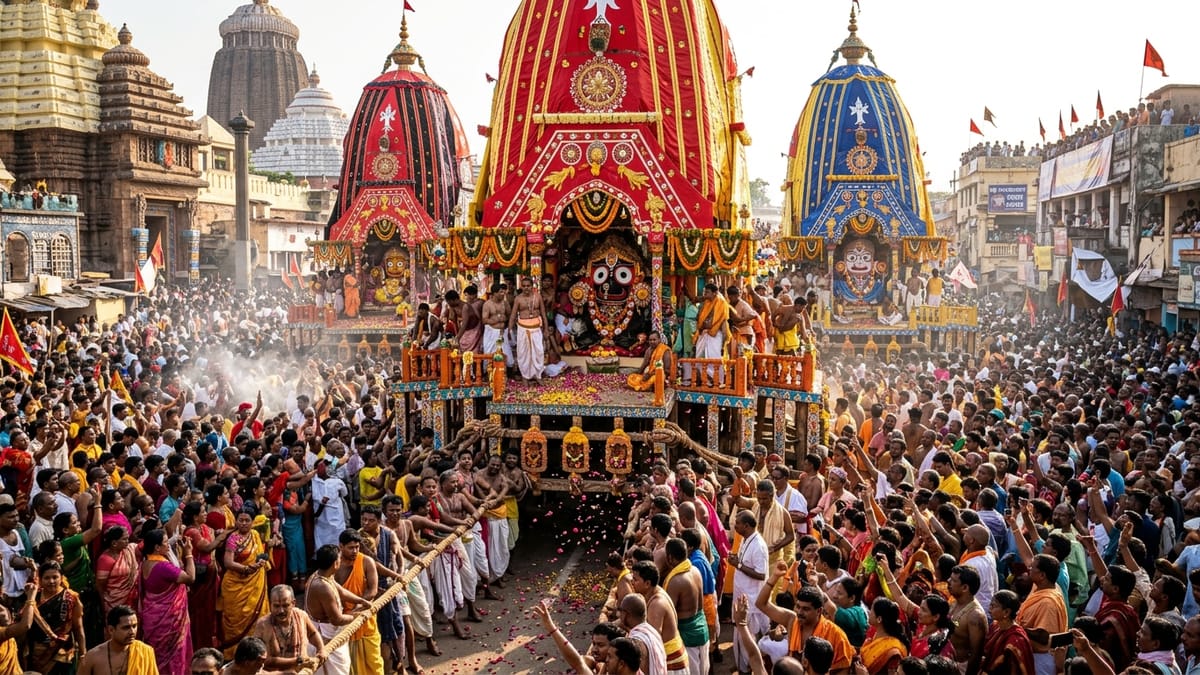
📖 The Divine Splendor of Ashadhi Bij: Rath Yatra & Kutchi New Year
Ashadhi Bij (also known as Ashadha Shukla Dwitiya or Ashadhi Dooj) is one of the most vibrant, auspicious, and culturally momentous festivals in the Sanatana Vedic calendar. Celebrated on the second day of the waxing moon in the sacred Hindu month of Ashadha, this holy date unites three magnificent celebrations across India:
- The World-Famous Jagannath Rath Yatra: The cosmic chariot festival of Bhagwan Jagannath (the Lord of the Universe), His elder brother Lord Balabhadra, and sister Devi Subhadra, rolling out in majestic glory in Puri (Odisha) and Ahmedabad (Gujarat).
- Kutchi New Year (કચ્છી નૂતન વર્ષ): Celebrated with supreme exuberance by the Kutchi diaspora across Kutch, Gujarat, Mumbai, and worldwide as their traditional New Year’s Day, marking prayers for rainfall, agricultural wealth, and familial prosperity.
- Arrival of the Auspicious Monsoons (Megh Malhar): Farmers across western India celebrate the scent of fresh rain on parched soil, perform Hal Pujan (worship of farming implements), and sow the summer Kharif crops.
Ashadhi Bij epitomizes universal harmony, where the Supreme Lord Himself leaves His inner temple sanctuary to travel among the people on open chariots, bestowing liberation (Moksha) upon all who gaze upon Him or touch the sacred chariot ropes. You can verify real-time localized auspicious timings using our Live Choghadiya & Vedic Panchang Engine.
📖 Ashadhi Bij 2027: Exact Tithi Timings & Astronomical Schedule
In the year 2027, Ashadhi Bij falls on Tuesday, July 6, 2027, under the auspicious Udaya Tithi (sunrise reckoning) of Ashadha Shukla Paksha. Astrological calculations for Indian Standard Time (IST) confirm an exceptionally pure alignment:
| Panchang Element | Exact Astrological Timing (IST) | Vedic Significance |
|---|---|---|
| Dwitiya Tithi Begins | Tuesday, July 06, 2027 at 01:19 AM | Tithi starts before dawn; entire solar day is sanctified |
| Dwitiya Tithi Ends | Tuesday, July 06, 2027 at 09:52 PM | Active continuously through sunrise, daytime, and evening |
| Sunrise (Suryodaya) | 05:54 AM IST (July 06, 2027) | Udaya Dwitiya established; ideal for Pratah Mangala Aarti |
| Sunset (Suryasta) | 07:22 PM IST (July 06, 2027) | Evening Sandhya Aarti and Sandhya Chariot ceremonies |
| Rath Yatra Rollout Window | 07:00 AM – 11:30 AM | Pahind Vidhi, golden broom sweeping & chariot pulling |
Auspicious Choghadiya Muhurat Windows on Tuesday, July 6, 2027:
- Chal Choghadiya: 09:16 AM – 10:57 AM (Auspicious for inaugurating journeys & processions)
- Labh Choghadiya: 10:57 AM – 12:38 PM (Supreme commercial and spiritual merit)
- Abhijit Muhurat: 12:16 PM – 01:08 PM (Midday divine victory window)
- Amrit Choghadiya: 12:38 PM – 02:19 PM (Everlasting nectar-like blessings)
- Shubh Choghadiya: 04:00 PM – 05:41 PM (Peaceful evening devotional window)
For city-wise planetary transitions and year-round dates, view our Shubh Muhurat Calendar 2026-2027.
📖 Puri & Ahmedabad Jagannath Rath Yatra: Legends & Grand Chariots
The Jagannath Rath Yatra is the oldest and grandest chariot festival on earth, described reverently in the Skanda Purana, Brahma Purana, and Padma Purana. The famous proverb declares: "Rathe tu vamanam drishta punarjanmam na vidyate"—Whoever beholds Lord Jagannath upon His celestial chariot is liberated from the cycle of rebirth.
1. The Three Holy Chariots (Rathas):
- Nandighosha (Garudadhwaja): The majestic chariot of Lord Jagannath. It stands 45 feet high, features 16 colossal wooden wheels, and is adorned with yellow and red silk canopies.
- Taladhwaja (Langaladhwaja): The towering chariot of elder brother Lord Balabhadra. It stands 44 feet high, features 14 wheels, and is draped in green/blue and red fabrics.
- Darpadalana (Padmadhwaja): The chariot of their beloved sister Devi Subhadra. It stands 43 feet high, features 12 wheels, and is decorated in red and black fabrics.
2. The Grand Ahmedabad Rath Yatra (Gujarat’s Supreme Pride):
In Gujarat, the annual Ahmedabad Jagannath Rath Yatra, originating from the 400-year-old historic Jagannath Temple in Jamalpur, is the second largest Rath Yatra in the world. The day unfolds with magnificent regal traditions:
- Mangala Aarti (04:00 AM): Attended by top dignitaries and thousands of devotees. Lord Jagannath is offered the traditional Khichdi and Makkhan-Mishri bhog.
- Pahind Vidhi (07:00 AM): In a centuries-old royal tradition, the Chief Minister of Gujarat cleans the path in front of the chariots with a golden broom (Sonani Sadhedi) before the chariots begin moving.
- Procession of Unity: The 16-kilometer historic procession features 18 caparisoned elephants, 101 colorfully decorated trucks showcasing Sanatan heritage, 30 wrestling akhadas performing gymnastics, and dozens of bhajan mandalis.
- Saraspur (Lord's Mosaal): The chariots arrive at Saraspur, regarded as Lord Krishna's maternal uncle’s home (Mosaal). The entire neighborhood welcomes over two lakh visiting pilgrims with unconditional communal banquets (Bhandaras) serving pure ghee Mohanbhal, hot Puri, and Gujarati Khichdi.
📖 Kutchi New Year (કચ્છી નૂતન વર્ષ): History, Megh Vandan & Customs
For the vibrant Kutchi community worldwide, Ashadhi Bij is celebrated as their sacred Kutchi New Year (કચ્છી નવું વર્ષ). Unlike the general Gujarati New Year (Bestu Varsh) which falls the day after Diwali, the Kutchi calendar begins on Ashadha Shukla Dwitiya:
1. The Legend of King Jam Lakho:
Historical chronicles of Kutch narrate that King Jam Lakho Ghuraro, a beloved and chivalrous ruler of Kutch, returned triumphantly to his homeland on Ashadhi Bij after a long exile. His auspicious arrival coincided with the breaking of a severe drought as thunderous rainclouds drenched the parched land of Kutch. In jubilation, the people established Ashadhi Bij as the official first day of the Kutchi Vikram Samvat era.
2. Traditional Celebrations & Greetings:
- Joyful Greetings: Kutchis greet one another warmly with "અષાઢી બીજ જો કચ્છી નયે વરે જી લખ લખ વધાઈયું" (Lakh Lakh Vadhaaiyu for the Kutchi New Year).
- Megh Vandan & Rain Forecasts: Farmers and astrologers observe the wind direction, cloud formations, and temperature on Ashadhi Bij to predict the quality of the upcoming monsoon season.
- Cultural Heritage: Kutchi folk dances, Sufi musical recitals, Dholak beats, and traditional Kutchi cuisines bring communities together across Bhuj, Mandvi, Anjar, Gandhidham, Mumbai, and global overseas associations.
Explore inspiring devotional sagas on our Pavitra Vrat Kathas Portal.
📖 Ashadhi Bij Domestic Puja Vidhi, Traditional Prasad & Offerings
Devotees who cannot travel to Puri or Ahmedabad celebrate Ashadhi Bij with immense sanctity in their homes and local temples:
- Pratah Snana & Yellow Attire: Rise early during Brahma Muhurta. Bathe in water mixed with Gangajal. Wear clean yellow, saffron, or white clothes.
- Altar Setup: Set up a wooden chowki covered with yellow silk cloth. Place idols or pictures of Lord Jagannath, Balabhadra, and Devi Subhadra. If not available, worship Lord Krishna and Balarama with Shri Ganesha.
- Panchamrit Abhishekam: Clean the deities with pure water and offer Panchamrit. Decorate with fragrant yellow sandalwood (Chandan), Kumkum, Akshat, and fresh Tulsi leaves.
- The Sacred Ashadhi Bij Prasad:
- Sprouted Green Moong (Mag): Symbol of new agricultural germination, vitality, and health.
- Fresh Ripe Jamun (Jambu): The dark purple monsoon fruit regarded as Lord Krishna’s favorite cooling offering.
- Tender Cucumber (Kakdi): Refreshing offering representing purity.
- Malpua & Boondi: Sweet delicacies traditionally distributed in Jagannath temples.
- Aarti & Chariot Darshan: Light a ghee deepak, wave incense, and sing the Jagannath Aarti with conch shells (Shankha) and brass bells.
📖 Potent Jagannath Stotras & Mantras for Prosperity
Chanting these sacred hymns on Ashadhi Bij destroys negative karmas and invites divine joy into home and family:
✨ Jagannath Ashtakam (by Adi Shankaracharya):
"कदाचित् कालिन्दी-तट-विपिन-सङ्गीत-तरलो
मुदाभीरी-नारी-वदन-कमलास्वाद-मधुपः |
रमा-शम्भु-ब्रह्मा-सुरपति-गणेशार्चित-पदो
जगन्नाथः स्वामी नयन-पथ-गामी भवतु मे ||"
Meaning: May that Lord of the Universe, Jagannatha, whose holy lotus feet are worshipped by Lakshmi, Shiva, Brahma, Indra, and Ganesha, graciously become the object of my vision!
📿 Divine Jagannath Mahamantra:
"हरे कृष्ण हरे कृष्ण कृष्ण कृष्ण हरे हरे |
हरे राम हरे राम राम राम हरे हरे ||"
Read more hymns and stotras on our Vedic Mantras Portal.
📖 Track Authentic Hindu Festival Muhurats on Your Mobile
Download Hindu Calendar Mobile App
Never miss an auspicious Rath Yatra muhurat, Kutchi New Year date, or daily Choghadiya! Get city-specific Vedic Panchang calculations, interactive 108 Japa Mala, Vrat Kathas, and festival notifications directly on your phone.
⚡ Get Hindu Calendar on Google Play Store100% Free • Works Offline • Accurate Astronomical Calculations