📖 Vat Savitri 2027: Regional Traditions Explained (Amavasya vs Purnima)
Vat Savitri Vrat is one of the most venerated and spiritually potent penances observed by married Hindu women (Suhagans) across the Indian subcontinent for the longevity, supreme health, and prosperity of their husbands, as well as by unmarried maidens seeking a virtuous spouse. Across different geographical regions of India, the fast is celebrated under two traditional astrological calendars:
- Vat Savitri Amavasya (Purnimanta Calendar): Celebrated primarily in North India—including Uttar Pradesh, Bihar, Madhya Pradesh, Delhi, Punjab, Haryana, and Rajasthan—on Jyeshtha Krishna Amavasya. In 2027, Vat Savitri Amavasya falls on Friday, June 4, 2027. This sacred day coincides with Shani Jayanti (the appearance day of Lord Shani Dev).
- Vat Purnima Vrat (Amanta Calendar): Celebrated primarily in Western and Southern India—including Gujarat, Maharashtra, Goa, and Karnataka—on Jyeshtha Shukla Purnima (lovingly known in Gujarat as Jethi Punam). In 2027, Vat Purnima falls on Saturday, June 19, 2027.
While the dates differ by exactly fifteen lunar days due to the Purnimanta versus Amanta reckoning, the divine spirit, the sacred banyan tree worship (Vat Puja), the fasting rules, and the recitations of the immortal Satyavan-Savitri Katha remain completely unified. You can track real-time localized auspicious timings using our Live Choghadiya & Vedic Panchang Engine.
📖 Vat Savitri 2027: Complete Tithi Timings & Auspicious Muhurats
According to authentic Vedic Drik Siddhanta calculations, both festive milestones offer dedicated morning worship windows:
| Observance | Tithi Begins (IST) | Tithi Ends (IST) | Fast Date & Best Puja Window |
|---|---|---|---|
| Vat Savitri Amavasya (North India) | 04:11 AM on Friday, June 4, 2027 | 01:16 AM on Saturday, June 5, 2027 | Friday, June 4, 2027 Morning Puja: 05:48 AM – 10:30 AM (Shubh & Chara) |
| Vat Purnima Vrat (Gujarat & Maharashtra) | 06:11 AM on Saturday, June 19, 2027 | 08:14 AM on Sunday, June 20, 2027 | Saturday, June 19, 2027 Morning Puja: 06:11 AM – 10:35 AM (Shubh & Amrit) |
Auspicious Choghadiya Muhurat Windows on Vat Savitri Days:
- Friday, June 4, 2027 (Amavasya):
- Chara Choghadiya: 05:48 AM – 07:30 AM
- Labha & Amrita Choghadiya: 07:30 AM – 10:54 AM
- Abhijit Muhurat: 12:12 PM – 01:04 PM
- Shubha Choghadiya: 12:36 PM – 02:18 PM
- Saturday, June 19, 2027 (Purnima):
- Shubha Choghadiya: 07:30 AM – 09:12 AM
- Amrita Choghadiya: 09:12 AM – 10:55 AM
- Abhijit Muhurat: 12:14 PM – 01:06 PM
- Labha Choghadiya: 02:20 PM – 04:02 PM
For city-wise planetary transitions and auspicious dates throughout the year, explore our comprehensive Shubh Muhurat Calendar 2026-2027.
📖 Spiritual Symbolism of the Sacred Banyan Tree (Vat Vriksha)
In Vedic theology, the Banyan Tree (Vat Vriksha / Bargad) is not merely botanical flora, but an immortal cosmic entity representing the Tridevas (the Holy Trinity):
- Roots (Mula): Embody Lord Brahma, the Creator of the universe.
- Trunk (Madhya): Embodies Lord Vishnu, the Sustainer and Preserver.
- Branches and Canopy (Shakha): Embody Lord Shiva (Rudra), the Destroyer of ignorance and fear.
- Entire Manifest Tree: Symbolizes Mata Savitri, the divine personification of Gayatri and virtuous devotion.
The Banyan tree possesses the miraculous ability to send down aerial roots (prop roots) that take fresh root in the soil, making the tree virtually immortal (Akshaya Vat). Worshipping the Vat Vriksha invokes longevity, vitality, and immortality into the marital bond, ensuring that a woman's married state (Saubhagya) remains evergreen and indestructible like the sacred tree itself.
📖 The Immortal Legend of Sati Savitri & Satyavan from the Mahabharata
The epic narrative of Vat Savitri is chronicled in the Vana Parva of the Mahabharata, narrated by Sage Markandeya to Pandava king Yudhishthira:
Princess Savitri, the radiant and pure daughter of King Ashwapati of Madra Desha, chose prince Satyavan as her husband. Satyavan was the noble son of King Dyumatsena of Shalwa, who had lost his sight and kingdom and was living as an impoverished hermit in the dense forest. When Devarshi Narada visited the royal court, he forewarned that although Satyavan possessed every divine virtue, he was cursed to die exactly one year from that very day.
Unshaken in her resolve, Savitri replied: "A maiden chooses her lord only once in a lifetime. Be his life long or short, I have surrendered my heart to Satyavan." She renounced all royal luxuries and accompanied her husband to the hermitage. Three days before the destined date of death, Savitri commenced a rigorous waterless fast (Triratra Vrat).
On the fateful day of Jyeshtha Amavasya, Savitri accompanied Satyavan into the deep woods to gather firewood. While cutting branches beneath a colossal Banyan tree, Satyavan felt overwhelming exhaustion and laid his head in Savitri's lap. Moments later, Lord Yamraj, the God of Death, arrived in his majestic dark form holding the noose of mortality (Pasha) and drew forth Satyavan's thumb-sized subtle soul (Angustha-matra Purusha).
As Lord Yama began his southward journey towards the netherworld, Savitri steadfastly followed him. Astounded by her fearless presence, Yamraj repeatedly asked her to turn back, reminding her that mortals cannot traverse the path of death. However, with unparalleled wisdom, eloquence, and profound knowledge of Dharma, Savitri engaged Lord Yama in sublime spiritual discourse. Delighted by each of her virtuous speeches, Yamraj offered her boons, excluding the life of Satyavan:
- First Boon: Restoration of eyesight and health to her blind father-in-law, King Dyumatsena.
- Second Boon: Restoration of his lost kingdom and imperial glory.
- Third Boon: One hundred valiant sons to her father, King Ashwapati, to carry forward his royal lineage.
When Lord Yama urged her to return after granting the third boon, Savitri praised the sanctity of righteousness and righteousness among gods, inspiring Yama to offer one final wish. Savitri humbly requested: "O Lord of Dharma! Grant that I may bear one hundred righteous sons born of my own womb from my lawful husband Satyavan, to perpetuate our lineage."
Lord Yama joyfully proclaimed, "Tathastu (So be it)!" Smiling serenely, Savitri pointed out: "O Lord, you have blessed me with a hundred sons from Satyavan, yet you carry away his soul. How can your divine blessing bear fruit without my husband's life?" Realizing her peerless devotion, intellectual brilliance, and chaste righteousness (Pativrata Dharma), Lord Yama smiled warmly, released Satyavan's soul from his noose, and blessed them both with four hundred years of healthy, prosperous life on earth. Satyavan awoke under the sacred Banyan tree as if rising from a deep slumber, and the couple returned home in triumph.
Read more inspiring Puranic episodes on our Pavitra Vrat Kathas Portal.
📖 Step-by-Step Vat Savitri Puja Vidhi & 7-Parikrama Ritual
Observing the traditional Vat Savitri Puja with purity and devotion safeguards domestic bliss. Follow this authentic step-by-step ritual sequence:
- Pratah Snana & Shodasha Shringar: Rise during Brahma Muhurta. Bathe with Gangajal-infused water. Wear a clean red, yellow, or orange traditional saree (avoid black and dark blue). Adorn yourself with the traditional sixteen bridal ornaments (Shodasha Shringar), applying auspicious Sindoor, golden bangles, bindi, anklets, and mehendi.
- Puja Thali Preparation: Arrange a brass or copper plate with:
- Soaked black chickpeas (Kala Chana / Chana dal).
- Fresh seasonal fruits (especially mangoes, bananas, and melons).
- Wet clay (Mitti) idols or betel nuts symbolizing Satyavan, Savitri, and Yamraj.
- A spool of unspun raw white or yellow cotton thread (Kacha Sutra / Moli).
- A hand fan made of palm leaves or bamboo (Bījanā / Pankha).
- Roli, Kumkum, Chandan, unbroken rice (Akshat), fresh flowers, and sweets (Boroi / Peda).
- A copper Kalash filled with pure water and a lit pure cow ghee lamp.
- Tree Consecration: Reach a sacred Banyan tree (or a freshly cut banyan branch installed in a clean pot at home). Sprinkle pure water, raw milk, and Gangajal at the root of the tree. Apply Chandan, Kumkum, and Akshat to the bark.
- Naivedya & Fan Offering: Offer soaked black gram, ripe mangoes, sweets, and flowers at the base of the tree. Gently fan the deity and the banyan tree with the hand fan to provide relief from summer heat.
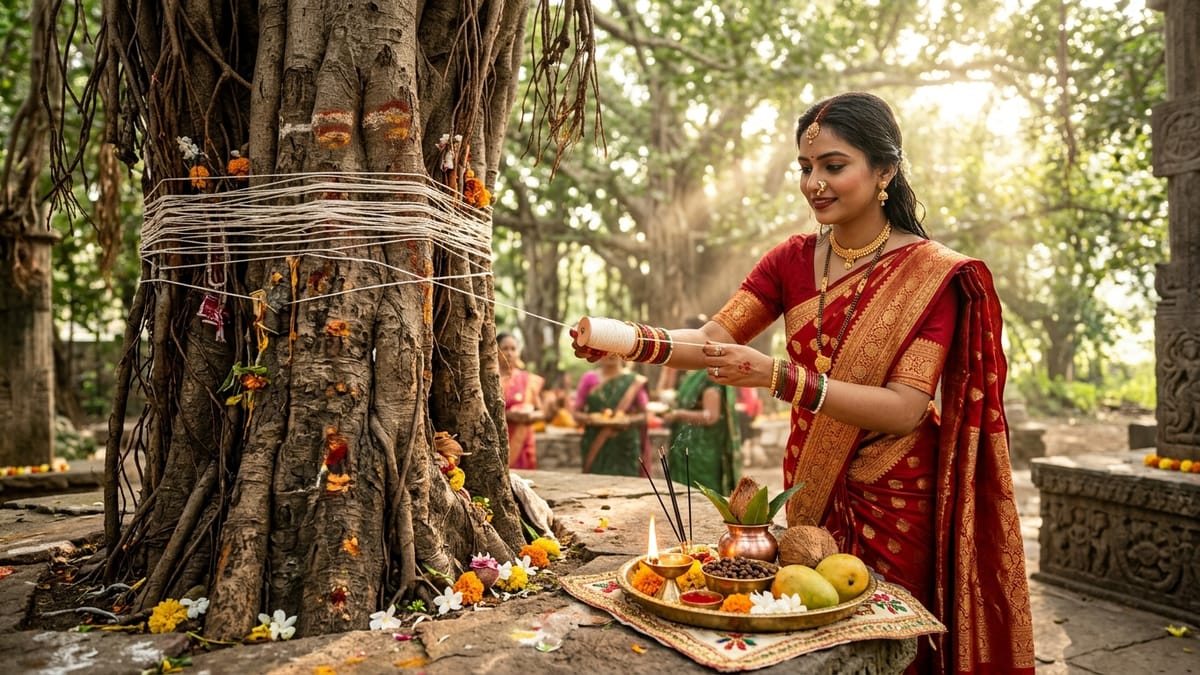
- The Sacred 7-Parikrama Thread Wrapping: Hold the raw cotton thread (Kacha Sutra) in your hand. Circumambulate the sacred trunk seven times (or 108 times for special vows) in a clockwise direction, wrapping the raw thread around the trunk while praying for the eternal protection and longevity of your husband.
- Katha Shravana: Sit peacefully near the tree and recite or listen to the full Satyavan-Savitri Vrat Katha.
- Aarti & Elder Blessings: Perform Karpura Aarti of the Banyan tree. Touch the feet of your mother-in-law, elders, and husband to seek their blessings.
- Vrat Parana (Fast Breaking): Break the fast by swallowing seven or twelve whole sprouted black chickpeas (Chana) with fresh water and eating seasonal mango Prasad. Distribute food, soaked chana, fans, and suhag samagri to Brahmins and elderly women.
📖 Potent Vedic Mantras for Akhand Saubhagya & Longevity
Chant these auspicious Sanskrit hymns during the Banyan tree circumambulation and prayer:
🌿 Vat Vriksha Vandana Mantra:
"नमो वैवस्वताय धर्मराजाय धीमते |
अक्षय्यं तस्य दातव्यं यमस्य सदनं गते ||
अवैधव्यं च सौभाग्यं देहि त्वं मम सुव्रते |
पुत्रान् पौत्रांश्च सौख्यं च गृहाणार्घ्यं नमोऽस्तु ते ||"
Meaning: O sacred Banyan tree and righteous Lord Yama! Bestow upon me unbroken marital bliss (Avaidhavya), prosperity, children, and grandchildren. Accept my humble offerings.
✨ Savitri Prarthana Mantra:
"ॐ सावित्री त्वं सुवस्त्रा च सौभाग्यायुर्वर्धिनी |
त्वं मां पालय कल्याणि कामान् पूरय सुव्रते ||"
Explore more sacred hymns on our Vedic Mantras Portal.
📖 Track Authentic Hindu Festival Muhurats on Your Mobile
Download Hindu Calendar Mobile App
Never miss an auspicious Vat Savitri puja muhurat, Amavasya or Purnima tithi, or daily Choghadiya! Get city-specific Vedic Panchang calculations, full Vrat Kathas, 108 Japa Mala, and festival notifications directly on your phone.
⚡ Get Hindu Calendar on Google Play Store100% Free • Works Offline • Accurate Astronomical Calculations