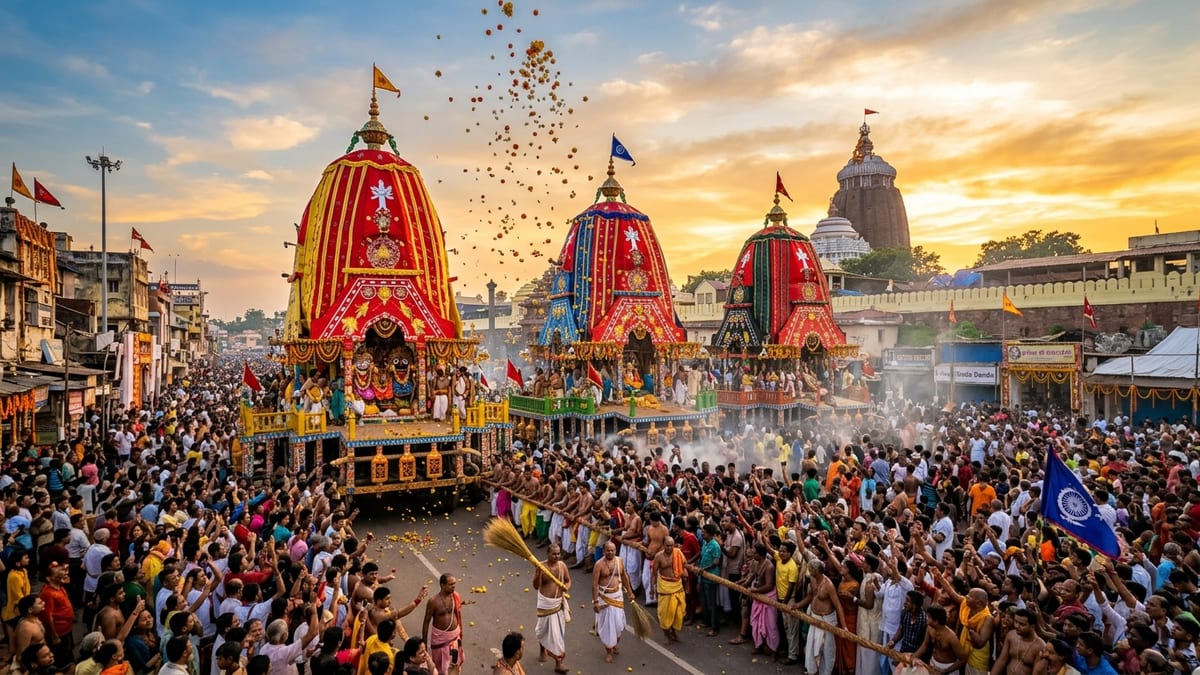
📖 1. Divine Glory & Spiritual Significance of Jagannath Rath Yatra
The world-renowned Shri Jagannath Rath Yatra (श्री जगन्नाथ रथयात्रा) is one of the most magnificent, sacred, and ancient congregational festivals on Earth. Celebrated annually on Ashadha Shukla Dwitiya (the second day of the waxing moon in the Vedic month of Ashadha), this grand spiritual procession embodies supreme compassion. On this auspicious day, the Supreme Lord of the Universe, Lord Jagannath (an endearing form of Shri Krishna), steps out of the sanctum sanctorum of the holy Jagannath Temple in Puri alongside His elder brother Lord Balabhadra (Balarama) and beloved sister Devi Subhadra, together with the divine celestial weapon Sudarshana Chakra, to bestow unreserved darshan upon all living beings.
Ancient Vedic scriptures, including the Skanda Purana and Brahma Purana, proclaim the matchless liberation granted by the festival with the immortal Sanskrit aphorism:
(Rathe tu vamanam drishtva punarjanma na vidyate.)
"One who beholds Lord Jagannath, the supreme dwarf incarnation (Vamana / Purushottama), seated upon His chariot, is forever liberated from the cycle of birth and death (samsara)."
Unlike traditional temple deities who remain stationary within the inner sanctum accessible only to priests and temple-goers, Lord Jagannath steps down to the open streets (Bada Danda) so that people of every caste, creed, nationality, and background—even the infirm, the birds, and wandering pilgrims—can drink in His merciful large, lotus-like round eyes. It represents the pinnacle of divine egalitarianism and unconditional grace in Sanatan Dharma.
📖 2. Complete 2027 Dates & 10-Day Multi-Phase Festival Calendar
In the year 2027, the sacred Ashadha Shukla Dwitiya tithi begins in the early hours of Tuesday, July 6 at 01:19 AM IST and concludes at 09:52 PM IST. Since the Dwitiya tithi prevails at Vedic sunrise (Udaya Tithi at 05:54 AM IST), the principal Rath Yatra Day will be celebrated globally on Tuesday, July 6, 2027.
| Festival Phase / Ritual | Vedic Tithi | Gregorian Date (2027) | Spiritual Significance |
|---|---|---|---|
| Deva Snana Purnima | Jyeshtha Purnima | Saturday, June 19, 2027 | Grand ceremonial bath of Deities with 108 fragrant pots of sacred well water (Suna Kua); Gajanana Besha (Elephant Attire). |
| Anasara (14-day Seclusion) | Ashadha Krishna Pratipada to Chaturdashi | June 20 – July 3, 2027 | Deities contract sacred fever; secret Ayurvedic Phuluri Tela treatment and fruit/herb diet by Daitapatis in Anasara Ghar. |
| Netrotsava & Naba Jaubana Besha | Ashadha Amavasya / Pratipada | Sunday – Monday, July 4–5, 2027 | Restoration of divine youthful vision; fresh natural organic colors applied to the eyes of the deities. |
| Shri Jagannath Rath Yatra (Gundicha Yatra) | Ashadha Shukla Dwitiya | Tuesday, July 6, 2027 | Main Chariot Procession rollout from Jagannath Temple to Gundicha Temple (Shree Mandir to Janmapitha / Mosaal). |
| Hera Panchami | Ashadha Shukla Panchami | Friday, July 9, 2027 | Goddess Mahalaxmi visits Gundicha Temple in anger; slight symbolic breaking of Lord Jagannath's chariot Nandighosha. |
| Sandhya Darshan (Navami Darshan) | Ashadha Shukla Navami | Tuesday, July 13, 2027 | Evening darshan at Gundicha Temple granting merit equivalent to 10 years of regular temple darshan. |
| Bahuda Yatra (Return Rath Yatra) | Ashadha Shukla Dashami | Wednesday, July 14, 2027 | Return chariot journey of the deities back towards the Main Shreemandir; stop at Mausi Maa Temple for Poda Pitha. |
| Suna Besha (Golden Attire / Rajarajeshwara Besha) | Ashadha Shukla Ekadashi | Thursday, July 15, 2027 | Deities adorned on the chariots with 208 kg of exquisite pure gold ornaments, crowns, conch, and discus. |
| Adhara Pana | Ashadha Shukla Dwadashi | Friday, July 16, 2027 | Offering of sweet aromatic herbal beverage in huge cylindrical earthen pots, which are ritually broken for guardian spirits. |
| Niladri Bije (Return to Sanctum) | Ashadha Shukla Trayodashi | Saturday, July 17, 2027 | Deities return to Ratna Singhasana; Lord Jagannath pacifies Goddess Mahalaxmi by offering mouth-watering Rasagolas. |
For daily planetary alignments, Rahu Kaal intervals, and day-night auspicious time slots during the festival, always cross-reference Today's Live Choghadiya Timings.
📖 3. Architectural Marvel of the Three Sacred Chariots (Rathas)
Every year, three brand new colossal wooden chariots are meticulously constructed from scratch by hereditary master craftsmen (Bhois and Maharana carpenters) using sacred neem and phasi logs supplied by the royal estate of Ranpur and Dasapalla. Not a single iron nail, steel bolt, or modern adhesive is used; the entire multi-story wooden architecture is held together solely by intricate wooden joinery, mortise-and-tenon interlocking slots, and sacred coir ropes.
🚩 Nandighosha (Lord Jagannath)
- Also known as: Garudadhwaja / Kapidhwaja
- Canopy Fabric: Red and Yellow (Lord Vishnu's Pitambari)
- Height: 44 feet 2 inches (Largest chariot)
- Number of Wheels: 16 wheels (representing the 16 Kalas and 16 senses)
- Charioteer (Sarathi): Daruka
- 4 Wooden Horses: Sankha, Balahaka, Shweta, and Haridashwa (White color)
- Presiding Guardian: Garuda atop the flag mast
🚩 Taladhwaja (Lord Balabhadra)
- Also known as: Langaladhwaja
- Canopy Fabric: Red and Bluish-Green
- Height: 43 feet 3 inches
- Number of Wheels: 14 wheels (representing 14 planetary realms / bhuvanas)
- Charioteer (Sarathi): Matali
- 4 Wooden Horses: Tibra, Ghora, Dirghashrama, and Swarnanabha (Black color)
- Presiding Guardian: Ananta Shesha atop the flag mast
🚩 Darpadalana (Devi Subhadra)
- Also known as: Padmadhwaja / Devadalana
- Canopy Fabric: Red and Black
- Height: 42 feet 3 inches
- Number of Wheels: 12 wheels (representing the 12 solar months / Adityas)
- Charioteer (Sarathi): Arjuna
- 4 Wooden Horses: Rochika, Mochika, Jita, and Aparajita (Red color)
- Sacred Companion: Lord Sudarshana Chakra is seated alongside Devi Subhadra
📖 4. Sacred Rituals: Pahandi Bije, Chhera Panhara & Rope Pulling
The execution of Rath Yatra is defined by ancient royal protocol and deep devotional fervor. The three most anticipated moments on Ashadhi Bij are:
- Dhadi Pahandi (Pahandi Bije): The magnificent swaying procession where the heavy neem-wood idols are lovingly carried from the inner sanctum down the 22 holy steps (Baisi Pahacha) to the chariots. The deities wear large, ornate headgears made of flowers and bamboo known as Tahias, which rhythmically sway back and forth to the thunderous beats of ghanta (bronze cymbals), kahali (horns), and sankha (conch shells).
- Chhera Panhara (Golden Broom Sweeping): The supreme demonstration of humility in Hindu monarchy. The Gajapati Maharaja of Puri, revered as the first servitor (Aadya Sevak) of Lord Jagannath, arrives in an ivory palanquin. Dressed in unstitched white silks, the King sprinkles sandalwood scented water and sweeps the wooden floors of all three chariots with a broom made of pure gold filaments. This sacred ritual proclaims that before God, emperors and beggars are entirely equal.
- Ratha Tana (Pulling the Holy Ropes): Millions of devotees grip the thick sacred ropes (known as Sankhachuda ropes) attached to each chariot. The collective chanting of "Hari Bol! Jai Jagannath! Swami Jai Jagannath!" fills the atmosphere as the colossal chariots begin their slow, rumbling, ground-trembling march towards the Gundicha Temple.
Devotees seeking divine spiritual timing for new ventures, vehicle purchases, or family ceremonies during this holy period should explore verified dates in our comprehensive Shubh Muhurat Guide.
📖 5. The Grand Heritage of Ahmedabad Jagannath Rath Yatra
Outside of Puri, the largest and oldest Jagannath Rath Yatra in Western India takes place in Ahmedabad, Gujarat, originating from the 450-year-old historic Shri Jagannath Temple in Jamalpur. Founded in 1878 by Sant Mahant Narasimhadasji Maharaj, the Ahmedabad Rath Yatra spans a colorful 14-kilometer pilgrimage route through the historic walled city.
Key highlights of the Ahmedabad Rath Yatra include:
- Pahind Vidhi: Continuing the royal humility tradition of Puri, the Honorable Chief Minister of Gujarat performs the symbolic cleaning of the path of the Lord's chariot with a golden broom early in the morning before flags are unfurled.
- Saraspur Mosaal & Maha Feast: When the Rath Yatra reaches the Saraspur locality (revered as the maternal uncle's home or Mosaal of Lord Jagannath), over 200,000 to 300,000 devotees, sadhus, and spectators are treated to endless free hot feasts consisting of desi ghee mohanthal, puri, sabji, and traditional khichdi in every street and pol.
- Magnificent Procession Elements: The Ahmedabad procession features 18 lavishly caparisoned sacred elephants (Gajraj) leading the march, 101 decorated devotional trucks representing spiritual tableaux, 30 wrestling akharas displaying traditional acrobatics and stick martial arts, and over 1,000 revered sadhu-sants from across Bharat.
📖 6. Divine Mahaprasad, Sprouted Moong & Jamun Prasadam
The sacred food offered to Lord Jagannath, revered as Chhapanna Bhog Mahaprasad, is spiritually unique. Prepared in the world's largest traditional temple kitchen (Roshaghara) by 1,000 suaras (hereditary cooks), the food is cooked inside stacked earthen pots placed over wood fires. Miraculously, by divine design, the food in the topmost pot cooks first, followed downward sequentially.
During Ashadhi Bij, two very specific items are distributed to millions across Gujarat, Odisha, and Bengal as divine prasadam:
- Ankurit Moong (Sprouted Green Gram): Symbolizes nascent life, agricultural vitality, health, and cooling vitality as the monsoon sets in.
- Kala Jamun (Black Plum): Ripening precisely during the month of Ashadha, its deep purple-black hue mirrors the transcendental complexions of Lord Jagannath and Shri Krishna. Scientifically, it strengthens digestive immunity during seasonal weather shifts.
Explore inspiring spiritual stories and timeless mythological legends behind temple traditions in our curated Pavitra Vrat Kathas Archive.
📖 7. Sacred Jagannath Ashtakam & Shubh Choghadiya Muhurat
Chanting the holy Shri Jagannath Ashtakam, composed by Adi Shankaracharya at the holy Govardhana Matha in Puri, showers immense peace, removes planetary afflictions, and bestows bhakti:
॥ શ્રી જગન્નાથાષ્ટકમ્ (Shri Jagannathashtakam) ॥
कदाचित् कालिन्दीतटविपिनसङ्गीततरलो मुदाभीरीहारीवदनकमलास्वादमधुपः ।
रमाशम्भुब्रह्मामरपतिगणेशार्चितपदो जगन्नाथः स्वामी नयनपथगामी भवतु मे ॥ १ ॥
रथारूढो गच्छन् पथि मिलितभूदेवपटलैः स्तुतिप्रादुर्भावं प्रतिपदमुपाकर्ण्य सदयः ।
दयासिन्धुर्बन्धुः सकलजगतां सिन्धुसुतया जगन्नाथः स्वामी नयनपथगामी भवतु मे ॥ ५ ॥
Auspicious Day Choghadiya Muhurat on Tuesday, July 6, 2027:
- Char (ચલ / સામાન્ય શુભ): 09:16 AM – 10:57 AM (Favorable for movement, starting travel)
- Labh (લાભ / ઉત્તમ): 10:57 AM – 12:38 PM (Highly auspicious for chariot rolling and beginning rituals)
- Abhijit Muhurat: 12:16 PM – 01:08 PM (Most potent midday victory muhurat)
- Amrit (અમૃત / સર્વોત્તમ): 12:38 PM – 02:19 PM (Supreme blessings and prasadam distribution)
- Shubh (શુભ / કલ્યાણકારી): 04:00 PM – 05:41 PM (Auspicious evening darshan)
Learn more powerful stotras and Vedic mantras in our dedicated Mantras & Stotras Portal.
📲 Track Live 2026-2027 Tithi, Muhurat & Choghadiya On Your Mobile
Get real-time solar sunrise calculations, precise Choghadiya timers, Ekadashi parana reminders, Kundli matching, and comprehensive Hindu festival notifications 100% offline and free.
Download Sanatan Hindu Calendar App