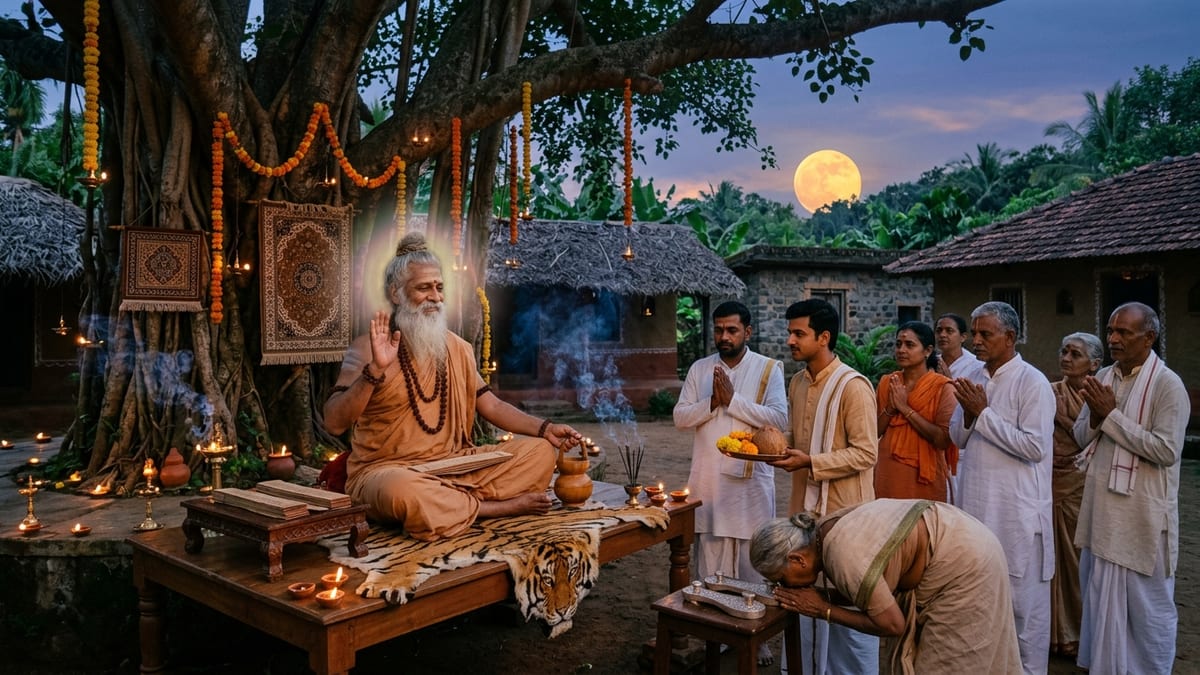
📖 1. Divine Significance of Guru Purnima in Sanatan Dharma
In the sacred tapestry of Sanatan Dharma, Guru Purnima (गुरु पूर्णिमा / વ્યાસ પૂર્ણિમા) stands as one of the most reverent, sublime, and spiritually transformative observances. Celebrated on the full moon day of the Vedic month of Ashadha (Ashadha Shukla Purnima), this auspicious day is dedicated to expressing boundless gratitude to one's spiritual master (Guru), teachers, mentors, and the unbroken lineage of enlightened sages (Guru Parampara).
The Sanskrit word Guru is composed of two profound root syllables:
- 'Gu' (गु): Signifies darkness, primal ignorance (avidya), spiritual blindness, and the worldly illusions of maya.
- 'Ru' (रु): Signifies the radiant light of wisdom, truth, and the dispeller of darkness.
Thus, the Guru is not merely an instructor of secular knowledge, but the divine bridge that leads an aspirant from the darkness of ignorance to the eternal luminescence of Self-realization. Vedic philosophy elevates the Guru to the status of the Supreme Divine Trinity through the immortal verse:
गुरुः साक्षात् परं ब्रह्म तस्मै श्रीगुरवे नमः ॥"
(Gurur Brahma Gurur Vishnuh Gurur Devo Maheshwarah; Guruh Sakshat Param Brahma Tasmai Shri Gurave Namah.)
"The Guru is Brahma (the Creator of inner awareness), the Guru is Vishnu (the Sustainer of righteous values), the Guru is Maheshwara (the Destroyer of ego and attachments). The Guru is verily the Supreme Absolute Reality manifest before our eyes. Salutations unto that holy Guru."
📖 2. Exact Date, Ashadha Purnima Tithi & Shubh Muhurat 2027
In the year 2027, the sacred Ashadha Shukla Purnima tithi spans from the evening of Sunday, July 18 to the evening of Monday, July 19. According to Vedic astronomical canons (Dharmasindhu and Nirnaysindhu), religious festivals celebrated at sunrise follow the Udaya Tithi rule. Because the full moon tithi prevails during Vedic sunrise on Monday, July 19, 2027, Guru Purnima and Vyasa Puja will be observed worldwide on this day.
| Vedic Aspect / Muhurat | Start Time (IST) | End Time (IST) | Spiritual Significance |
|---|---|---|---|
| Ashadha Purnima Tithi Begins | Sunday, 18 July 2027 at 07:56 PM | — | Commencement of Full Moon energy; ideal for evening meditation and fasting sankalp. |
| Ashadha Purnima Tithi Ends | — | Monday, 19 July 2027 at 07:38 PM | Conclusion of Purnima; Shravana Krishna Pratipada begins. |
| Brahma Muhurat (ब्रह्म मुहूर्त) | 04:28 AM | 05:16 AM | Supremely auspicious for sacred bath, Guru Dhyana, and silent Japa. |
| Vedic Sunrise & Sunset | Sunrise: 06:04 AM | Sunset: 07:27 PM | Full day of auspicious solar illumination on Monday, July 19, 2027. |
| Abhijit Muhurat (अभिजीत) | 12:18 PM | 01:10 PM | Most powerful midday victory window for initiating spiritual practices and Guru Dakshina. |
| Purnima Moonrise (ચંદ્રોદય) | 07:18 PM | — | Sacred Arghya to the Full Moon (Chandra Arghya) and Satyanarayan Maha Aarti. |
Auspicious Day Choghadiya Slots for Guru Purnima (Monday, July 19, 2027):
- Amrit (અમૃત / સર્વોત્તમ): 06:04 AM – 07:44 AM (Supreme for early morning Guru Paduka Pujan and Charan Sparsh)
- Shubh (શુભ / કલ્યાણકારી): 09:25 AM – 11:05 AM (Highly auspicious for visiting ashrams, Guru Dakshina, and Vastra Arpan)
- Char (ચલ / સામાન્ય શુભ): 02:26 PM – 04:06 PM (Favorable for spiritual travel, satsang, and pilgrimages)
- Labh (લાભ / ઉન્નતિકારક): 04:06 PM – 05:47 PM (Auspicious for spiritual initiation / Guru Diksha and Mantra Japa)
- Amrit (અમૃત / સર્વોત્તમ): 05:47 PM – 07:27 PM (Supreme for evening Guru Aarti, Bhajan, and Satyanarayan Vrat Katha)
Devotees can monitor live planetary hours, daily Rahu Kaal, and planetary movements in real time using our Today's Live Choghadiya Timings.
📖 3. Maharshi Veda Vyasa Jayanti & The Literary Foundation of Bharat
Guru Purnima is traditionally celebrated as Vyasa Purnima (व्यास पूर्णिमा), commemorating the sacred birth anniversary of Maharshi Krishna Dwaipayana Veda Vyasa, born to Sage Parashara and Devi Satyavati. Maharshi Vyasa is regarded as the archetype of all Gurus (Adi Guru of Vedic scriptures) and the literary architect of Sanatan civilization.
Prior to Maharshi Vyasa, the sacred Vedic knowledge existed as a singular, vast oral tradition. Recognizing that human intellect and lifespan would diminish in Kali Yuga, Sage Vyasa codified the sacred corpus into four structured Vedas:
- Rigveda: The Veda of divine hymns, cosmic order, and prayers, entrusted to his disciple Paila.
- Yajurveda: The Veda of sacrificial rituals, yajnas, and mantras, entrusted to Vaishampayana.
- Samaveda: The Veda of celestial melody and devotional music, entrusted to Jaimini.
- Atharvaveda: The Veda of everyday life, societal sciences, and spiritual remedies, entrusted to Sumantu.
Furthermore, Maharshi Vyasa authored the monumental epic Mahabharata (which contains the eternal philosophical crown jewel, the Bhagavad Gita), the 18 Maha Puranas, and the Brahma Sutras. On Guru Purnima, scholars, students, and spiritual seekers worship Sage Vyasa with the traditional salutation:
नमो वै ब्रह्मनिधये वासिष्ठाय नमो नमः ॥"
(Vyasaya Vishnu-roopaya Vyasa-roopaya Vishnave; Namo Vai Brahma-nidhaye Vasishthaya Namo Namah.)
"Salutations to Sage Vyasa, who is an embodiment of Lord Vishnu, and to Lord Vishnu, who manifested as Vyasa. Reverence unto the great descendant of Sage Vashistha, the supreme treasure-house of Vedic wisdom."
📖 4. Step-by-Step Guru Paduka Pujan & Vyasa Puja Vidhi at Home
Whether you are visiting your Guru's ashram or performing the worship at your home altar, follow this traditional Vedic protocol:
- Pratah Snana & Shuddhi: Awaken during Brahma Muhurat (around 04:30 AM). Take a purifying bath, wearing clean traditional yellow, white, or saffron unstitched attire.
- Altar Preparation: Clean your home temple or north-east corner (Ishanya Kona). Place a wooden stool (patta) covered with fresh yellow or white silk cloth.
- Installation of Images / Padukas: Place an image of Maharshi Veda Vyasa, Adi Shankaracharya, your Guru Maharaj, or sacred wooden Guru Padukas (charan-paduka).
- Deepa & Dhoopa Prajvalan: Light a two-faced brass lamp with pure cow's desi ghee and burn natural guggul or sandalwood incense.
- Abhishekam / Prokshana: Bathe the Guru Padukas gently with Ganga jal, followed by panchamrit (milk, curd, honey, sugar, and ghee), and conclude with holy water scented with rose water and cardamom.
- Chandan & Akshat Arpan: Apply yellow sandalwood paste (chandan) and fragrant kumkum on the Padukas. Offer unbroken sacred white rice grains (akshat) and fragrant yellow flowers (marigold, champa, or yellow roses).
- Guru Dakshina & Vastra: Devoutly offer yellow or saffron cloth, fresh fruits, whole dry coconut (shrifal), sweets (ladoo or peda), and voluntary dakshina according to your capacity.
- Charan Sparsh & Ashirwad: Bow your head completely to the ground (Sashtanga Dandavat Pranam), mentally surrendering your ego, doubts, and burdens at the Guru's holy feet.
For auspicious personal timelines, graha dosha remedies, and family milestones, consult our verified Shubh Muhurat Calendar.
📖 5. Sacred Guru Stotram & Chants for Spiritual Awakening
Chanting the Guru Stotram from the Uttara Khanda of the Skanda Purana generates powerful spiritual vibrations, removes intellectual obstacles, and invites divine blessings:
॥ શ્રી ગુરુ સ્તોત્રમ્ (Shri Guru Stotram) ॥
अखण्डमण्डलाकारं व्याप्तं येन चराचरम् ।
तत्पदं दर्शितं येन तस्मै श्रीगुरवे नमः ॥ १ ॥
अज्ञानतिमिरान्धस्य ज्ञानाञ्जनशलाकया ।
चक्षुरुन्मीलितं येन तस्मै श्रीगुरवे नमः ॥ २ ॥
ध्यानमूलं गुरोर्मूर्तिः पूजामूलં गुरोः पदम् ।
मन्त्रमूलं गुरोर्वाक्यं मोक्षमूलं गुरोः कृपा ॥ ३ ॥
Meaning & Inner Realization:
- "Dhyana-moolam Guror-moortih": The ultimate object of meditation is the radiant form of the Guru.
- "Pooja-moolam Guroh-padam": The root of all worship is the holy feet (padukas) of the Guru.
- "Mantra-moolam Guror-vakyam": The primary source of all sacred mantras is the word spoken by the Guru.
- "Moksha-moolam Guror-kripa": The sole cause and foundation of liberation (Moksha) is the unconditional grace (Kripa) of the Guru.
Immerse yourself in more divine stotras, kavachas, and sacred Vedic mantras in our specialized Mantras & Stotras Library.
📖 6. Interfaith Harmony: Traditions in Jainism, Buddhism & Chaturmas
Guru Purnima transcends sectarian boundaries, holding profound reverence across Indian spiritual traditions:
- Jain Tradition (Treenok Guru Pujan): In Jainism, Guru Purnima commemorates the day 24th Tirthankara Bhagwan Mahavira chose his chief disciple (Gandhara), Indrabhuti Gautama (Gautama Swami), at Vipulachala. Jains worship their monks, acharyas, and spiritual preceptors with great devotion.
- Buddhist Tradition (Dhammacakkappavattana Sutta): For Buddhists worldwide, Ashadha Purnima is celebrated as Asalha Puja. It marks the momentous day when Gautama Buddha delivered his historic first sermon at the Deer Park in Sarnath to his five ascetic companions, setting into motion the Wheel of Dhamma (Dharmachakra Pravartana).
- Commencement of Chaturmasya Vrata: For sadhus, sannyasins, and householders, Guru Purnima marks the formal beginning of the 4-month spiritual seclusion (Chaturmas Vrata). Wandering monks stay in one designated place for four months to study scriptures, meditate, and avoid harming nascent monsoon micro-life.
Read about holy fasting narratives, vrat vidhis, and mythological stories in our rich Pavitra Vrat Kathas Archive.
📖 7. Astrological Benefits of Guru Pujan & Remedies for Brihaspati
In Vedic astrology (Jyotish Shastra), the Guru represents Brihaspati (Jupiter), the planet of higher intellect (buddhi), spiritual illumination, fortune, progeny, righteous conduct (dharma), and divine grace. Honoring your Guru on Ashadha Purnima bestows profound karmic benefits:
- Mitigating Guru Chandal & Brihaspati Dosha: Worshipping the Guru and donating yellow items (gram dal, turmeric, yellow brass vessels, saffron sweets) neutralizes afflictions of Jupiter in the birth chart.
- Awakening Medha & Academic Success: Students who touch their teachers' feet and seek blessings on this day experience enhanced memory retention, cognitive clarity, and scholarly achievements.
- Dissolving Pitru & Karmic Debts: Sincere Guru seva dissolves past-life negative samskaras, attracting spiritual serenity and prosperity into the household.
📲 Track Exact Vedic Tithis, Muhurat & Choghadiya On Your Mobile
Download the Sanatan Hindu Calendar App for live Choghadiya timers, daily Vedic Panchang, Ekadashi parana timings, Kundli analysis, and offline festival reminders.
Download Sanatan Hindu Calendar App