⚔️ 1. Kali Chaudas 2027: Date, Chaturdashi Tithi & Astrological Calendar
Kali Chaudas (also venerated as Naraka Chaturdashi, Roop Chaudas, Bhoot Chaturdashi, and Choti Diwali) is the profoundly sacred second day of the grand five-day festival of lights, Deepotsav. Observed on the fourteenth lunar day (Chaturdashi) of the Krishna Paksha in the month of Kartik (Aso Vad Chaudas in Gujarat), this festival represents the annihilation of tyrannical demonic forces, eradication of fear, cleansing of physical and spiritual impurities, and the triumph of divine inner luminescence over darkness.
In the year 2027, Kali Chaudas is observed on Thursday, October 28, 2027. Because the Chaturdashi tithi commences late on Wednesday night and prevails across both the midnight hour (Maha Nishita Kaal) and the pre-dawn hours of Thursday, classical Dharma Shastras (Nirnaya Sindhu and Dharmasindhu) provide clear astronomical timings for both midnight Tantric/Vedic worship and pre-dawn Abhyanga holy bathing:
| Panchang / Astronomical Event | Exact Calculated Timing (IST) | Scriptural Context & Significance |
|---|---|---|
| Chaturdashi Tithi Begins | Wednesday, 27 October 2027 at 10:56 PM | Ingress of Kartik Krishna Chaturdashi |
| Chaturdashi Tithi Ends | Thursday, 28 October 2027 at 08:54 PM | Transition into Kartik Amavasya (Diwali Lakshmi Puja) |
| Maha Nishita Kaal (Mahakali Puja) | 11:39 PM to 12:30 AM (Midnight Oct 27-28) | Most potent nocturnal window for warding off negative forces |
| Abhyanga Snan (Roop Chaudas Snan) | 05:08 AM to 06:33 AM (Thursday Morning) | Pre-dawn holy bath with sesame oil, ubtan & Apamarga |
| Hanumanji Shindur Puja Muhurat | Morning 06:35 AM – 09:25 AM & Evening Pradosh | Bajrangbali worship for strength, health, and fearlessness |
| Yama Deepam (14 Sacred Deepams) | 05:40 PM to 07:15 PM (Thursday Evening) | Lighting 14 lamps at key thresholds before Amavasya |
Because Chaturdashi is active at sunrise on Thursday, 28 October 2027, the traditional Abhyanga Snan and daylight celebrations are universally held on Thursday. To check local sunrise and city-specific planetary hours, visit our Daily Vedic Panchang.
🪔 2. Maha Nishita Kaal Mahakali Puja Muhurat & Night Choghadiya
Unlike other festive days where daytime or twilight worship is prioritized, Kali Chaudas is spiritually rooted in Maha Nishita Kaal (the intense midnight two-ghati interval). According to the Shakta tradition, this midnight hour was when Mother Mahakali unleashed her unbridled cosmic force to vanquish ignorance, black magic, sorcery, ancestral curses, and demonic spirits.
| Nocturnal Muhurat Window | Time Duration (IST) | Spiritual Practice & Observance |
|---|---|---|
| Maha Nishita Kaal (Primary Slot) | 11:39 PM – 12:30 AM (Midnight) | Recitation of Kali Sahasranama, Bhairav Kavach, and lighting mustard oil lamps |
| Karka Lagna (Midnight Lagna) | 11:15 PM – 01:30 AM | Water sign ruled by Moon; provides emotional calm and mental resilience |
| Shubh & Amrit Night Choghadiya | 10:35 PM – 01:45 AM | Ideal for meditation, japa mala sadhana, and preparing sacred eye kajal |
Inspect live running Choghadiya timings for your city anytime on our Live Choghadiya & Shubh Timings Portal.
🧴 3. Roop Chaudas & Naraka Chaturdashi Abhyanga Snan: Sacred Pre-Dawn Holy Bath
On the morning of Thursday, October 28, 2027, between 05:08 AM and 06:33 AM (Arunodaya Kaal before sunrise), Hindus across India perform the sacred Abhyanga Snan. Scripture states that on this morning, Goddess Lakshmi resides in sesame oil (*Til Tel*), and Mother Ganga resides in all pure water:
"तैले लक्ष्मीर्जले गङ्गा दीपावल्यास्तिथौ वसेत्। अलक्ष्मीपरिहारार्थं स्नानं कुर्यात् प्रयत्नतः॥"
The 5 Steps of Traditional Abhyanga Snan:
- 1. Sesame Oil Massage: Warm, unrefined sesame oil (*Til ka tel*) or mustard oil is massaged thoroughly from head to toe. This lubricates the joints, purifies the lymphatic system, calms Vata dosha, and stimulates blood circulation in the cooling autumn season.
- 2. Herbal Ubtan Application: A fragrant paste made from chickpea flour (besan), turmeric (haldi), sandalwood powder, and rose water is applied to the skin. It gently exfoliates, cleanses dead cells, and bestows a radiant golden complexion (giving rise to the name Roop Chaudas).
- 3. The Apamarga Circling Ritual: Take a small twig of the sacred Apamarga plant (Chirchita / Latjira) with roots and leaves. Circle it over the head seven times clockwise while chanting: "सितालोष्टसमायुक्तं सकण्टकदलान्वितम्। हर पापमपामार्ग भ्राम્યમાણઃ પુનઃ પુનઃ॥". This symbolic action purges karmic sins, ill-health, and avoids passage through Naraka (hell).
- 4. Holy Warm Water Bath: Bathe with warm water infused with a few drops of Gangajal and rose petals, offering prayers to Lord Krishna and Mother Yamuna.
- 5. Fresh Apparel & Tilak: Wear fresh festive clothes (avoiding black) and apply a soothing chandan tilak on the forehead.
🏹 4. The Divine Legend: Lord Krishna, Satyabhama & Slaying of Narakasura
The central mythological glory of Naraka Chaturdashi is described in the Srimad Bhagavatam (10th Canto, Chapter 59) and the Vishnu Purana:
The demon king Narakasura (Bhaumasura), ruler of Pragjyotishapura, had grown immensely tyrannical through severe austerities. He terrorized all three worlds, snatched the divine earrings of Mother Aditi, captured the celestial white umbrella of Lord Varuna, and abducted 16,100 noble maidens, holding them captive in his impenetrable fortress.
Because Narakasura possessed a boon that he could only be slain with the involvement of a woman, Lord Sri Krishna mounted Garuda alongside his valorous consort, Satyabhama (an incarnation of Bhudevi, Narakasura's mother). In an epic nocturnal battle on Kartik Krishna Chaturdashi, Krishna and Satyabhama breached the demon's defenses, destroyed his generals, and slayed Narakasura with the Sudarshana Chakra.
Lord Krishna liberated all 16,100 imprisoned women, restored Mother Aditi's earrings, and anointed Narakasura's devout son, Bhagadatta, as the new king. Before dying, Narakasura repented and requested that his death be celebrated with lamps and joyous baths so that no soul observing this day with oil baths would suffer torment in hell. Lord Krishna washed off the battlefield blood and was lovingly bathed with fragrant oils by Satyabhama, establishing the eternal custom of Naraka Chaturdashi Abhyanga Snan.
🛡️ 5. Lord Hanuman & Goddess Mahakali: Dispelling Darkness, Evil Eye & Inner Demons
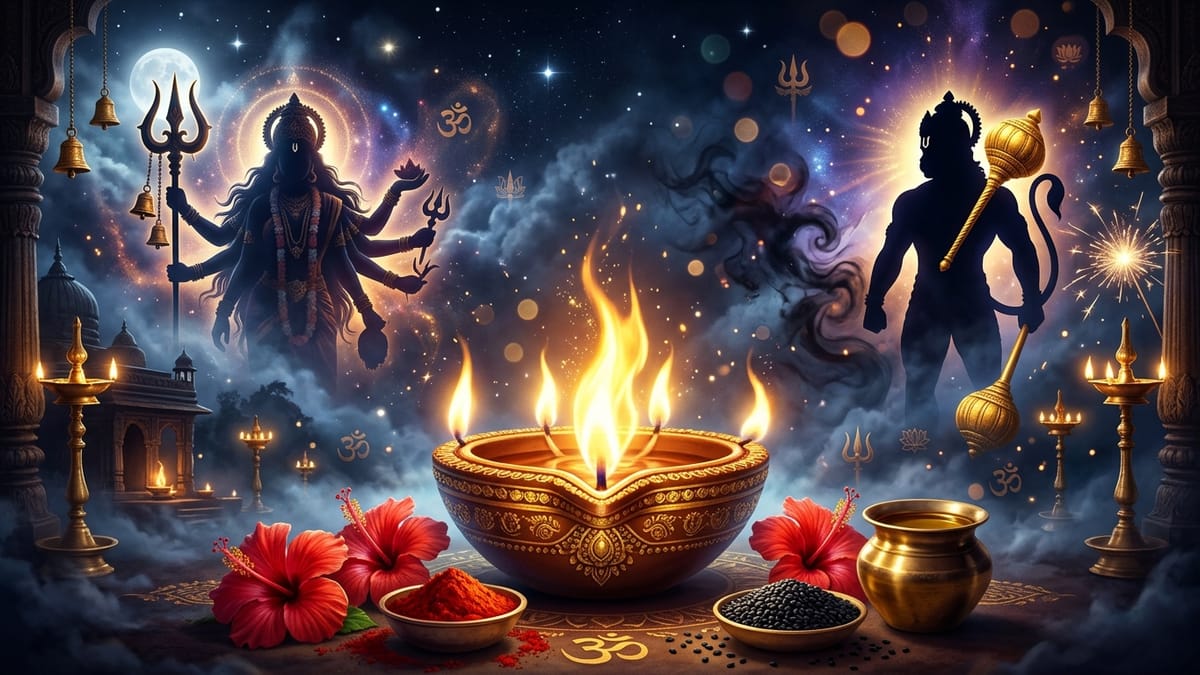
In addition to the Krishna legend, Kali Chaudas is intensely dedicated to two fierce yet infinitely compassionate guardian deities:
- Maa Mahakali (The Slayer of Darkness): Goddess Mahakali represents the supreme cosmic power (Adya Shakti) that incinerates ego, fear, depression, malevolent planetary spirits, and black magic. On this night, lighting a dark mustard-oil lamp with black sesame seeds in her honor eliminates household discord and protects against malefic planetary afflictions (especially Rahu and Saturn).
- Lord Hanuman (Sankat Mochan): Traditional lore from the Ramayana records that on this nocturnal period, Lord Hanuman entered Patala Loka to slay the sorcerer demons Ahiravana and Mahiravana, rescuing Lord Rama and Lakshmana. Worshipping Hanumanji on Kali Chaudas by applying vermilion mixed with jasmine oil (*Sindoor & Chameli Tel*), offering a garland of Calotropis flowers (*Akada Na Phool*), and chanting the Hanuman Chalisa or Bajrang Baan destroys all physical ailments, psychic distress, and ghost fears (*Bhoot Pishach Nikat Nahi Aave*).
For complete Diwali season celebrations, read about Dhanteras 2027 and the grand festival of Diwali 2026-2027 Puja Muhurat & Lakshmi Timings.
🍲 6. Unique Gujarati Traditions: Tal-Vada, Kheer, Kajal & "Kanklat Kadhvo"
In Gujarat, Kali Chaudas is celebrated with vibrant, time-honored folk traditions that have deep spiritual roots:
- Tal-Vada & Kheer Naivedya (તળેલા અડદના વડા): Gujarati households traditionally prepare deep-fried spicy Urad Dal Vada (અડદના વડા), puris, and sweet rice kheer. These are offered as sacred Naivedya to Mata Mahakali, Lord Bhairava, and Kuldevi. Urad dal is astrologically associated with Saturn and Rahu; preparing and consuming it on this day neutralizes negative planetary transits.
- Homemade Sacred Kajal (કાજળ / આંજણ): In the late evening, a pure cotton wick lamp filled with mustard or castor oil is lit. A small brass or copper plate smeared with pure ghee is suspended over the flame to collect dense black carbon soot. The resulting soot is mixed with a drop of ghee to create homemade sacred kajal (Aanjan). Applying this kajal to children's and family members' eyes is believed to bestow sharp vision and shield them from the "evil eye" (*Buri Nazar*).
- Kanklat Kadhvo (Eliminating Domestic Strife): "Kanklat" refers to household arguments, misunderstandings, and negative friction. In villages and towns, after dusk, women gather old pots, a lemon, and small offerings, gently tapping them to sweep away accumulated sorrow and friction outside the house boundaries, ensuring that peace (*Shanti*) reigns supreme for the New Year.
- Crossroads Offering (ચાર રસ્તા / વળાંક): A small portion of vada, grain, and lime is respectfully placed at clean crossroads (*Chowk*) as an offering to guardian spirits, praying for unimpeded household well-being.
🕉️ 7. Step-by-Step Kali Chaudas Puja Vidhi at Home
You can effortlessly perform this protective and auspicious puja in your home temple:
- 1. Purification & Altar Setup: In the evening or during Nishita Kaal, clean the altar area and sprinkle Gangajal. Spread a red or yellow cloth over a wooden chowki. Place an image or murti of Goddess Mahakali and Lord Hanuman.
- 2. Sanctification: Apply red vermilion (*Sindoor / Kumkum*) and unbroken rice (*Akshat*) to the deities. Offer fresh red hibiscus flowers (*Jaba Kusum*) or marigolds.
- 3. The Protective Lamp: Light an earthen lamp filled with pure mustard oil or sesame oil. Add a pinch of black sesame seeds (*Kala Til*) and a clove (*Laung*) into the oil. This absorbs and incinerates ambient negative energy.
- 4. Food Offerings (Bhog): Offer freshly prepared Urad dal vadas, sweet jalebis, kheer, fruits, and betel leaves (*Paan*) to Mata Kali and Bhairav Dada. Offer boondi laddoos and bananas to Lord Hanuman.
- 5. Recitation & Aarti: Chant the Kali Gayatri Mantra 11 times and read the Hanuman Chalisa. Perform the aarti with devotion and distribute the prasad to family members.
To discover more sacred fasting stories, explore our 54 Sacred Hindu Vrat Kathas Collection.
📿 8. Sacred Vedic & Tantric Mantras for Kali Chaudas
Chanting these sanctified mantras during the nocturnal window shields the practitioner and household from spiritual adversity:
Access daily sacred chants and your 108 digital mala counter in Divine Vedic Mantras & Stotras.
📱 9. Experience 100% Offline Vedic Wisdom on Your Phone
Download Sanatan Hindu Calendar Android App
Stay spiritually empowered with high-precision Vedic timing! The Sanatan Hindu Calendar App delivers accurate Abhyanga Snan timings, Nishita Kaal alerts, daily Choghadiya clock, 54 holy Vrat Kathas, 108 Japa Mala, and Janam Kundli—completely 100% offline, free, and privacy-first.